
Derinkuyu Entrance: Planning the Visitor Route
Independent guide; not the museum operator or an official ticket seller.
Find the Derinkuyu entrance, check admission and understand the narrow public route before arranging the return.
Last updated October 2026
Contents10
- Find the Derinkuyu entrance
- Before entering: tickets and opening checks
- What the public route involves
- Steps, low passages and physical constraints
- Allowing time without a false duration promise
- Guided versus independent entry
- Your return from the entrance
- Frequently asked questions
- Continue planning your visit
- Verdict on the Derinkuyu entrance
The Derinkuyu entrance is in the town of Derinkuyu, not in Göreme or at Kaymaklı Underground City. Use the museum's name and official address for the drop-off. Before going below ground, settle the ticket, the current visitor path and how you will return to your accommodation.
The Ministry lists the entrance address in Bayramlı Mahallesi on Şemşili Yolu Sokak. Inside, the site includes stairs and narrow links between rooms. The open path is managed by the museum and is not the full underground network. Check the day's access and ticket cutoff before travelling, especially if low spaces or steps may affect the visit.
Find the Derinkuyu entrance
The Ministry's venue listing gives Bayramlı Mahallesi, Şemşili Yolu Sokak, No. 15, Derinkuyu, Nevşehir. Save that address with the venue name. A regional search for “underground city” may bring up a different museum.
The mapping link in that listing is an arrival aid. It does not show where a queue will form or which door the staff use on a particular day. Follow current signs at the site. If a driver drops you nearby, ask which way to walk to the museum entrance and where you will meet again.
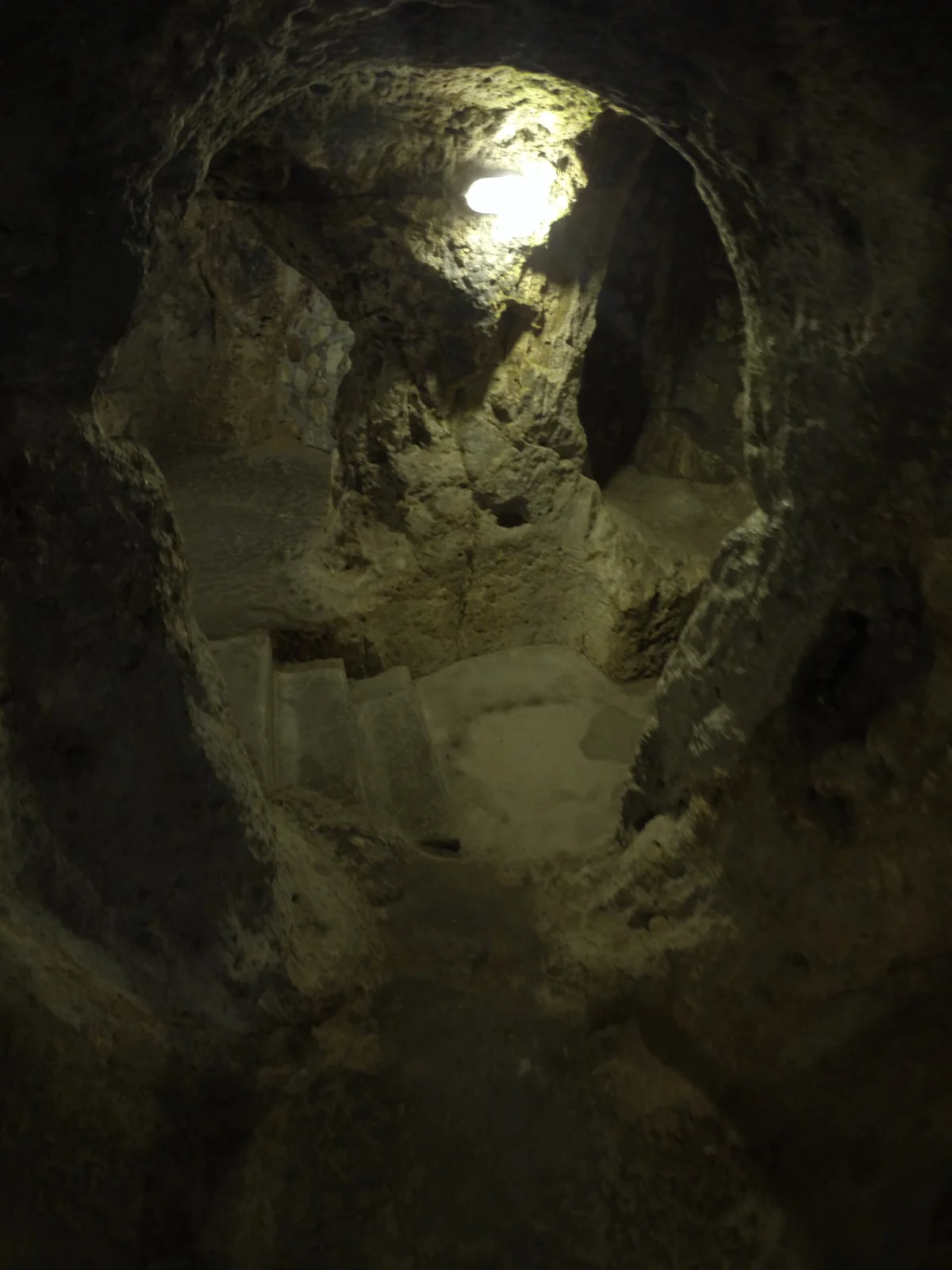
Do not use an interior photograph as a street-level landmark. The photo on this page shows a space inside Derinkuyu, with modern visit features. It does not identify the current ticket desk from the road. Location, admission and the underground path are three different tasks.
Check the venue name
A tour can include an underground city without promising Derinkuyu. Read the stop list before the day begins. If it names Kaymaklı or Özkonak, that is another venue, not another name for this entrance. Ask the supplier to settle any substitution before making the journey.
For a taxi, show the official listing rather than a picture copied from a travel page. For a tour, keep the product's saved route. For independent driving, save the museum destination before leaving the hotel. Each approach benefits from the same exact venue identity.
Before entering: tickets and opening checks
Admission is separate from transport unless your booked package clearly includes it. Ask the desk or supplier which ticket applies to your visitor category. A pass name alone is not enough; check its exact coverage and eligibility. A rule for Turkish citizens may not cover a visitor from abroad.
The Turkish Museums page lists entry categories. Its published hours differ from the live Ministry listing. Both were checked in October 2026. We do not merge those records into a single confirmed late-entry window.
Check the ticket-office cutoff as well as the site's closing time. It is earlier in both records. Leave enough room to arrive, find the desk and enter under the venue's rules. A drive that reaches town near closing is not the same as a workable museum visit.
A short entrance checklist
- Confirm Derinkuyu is the booked underground site.
- Recheck the venue's hours and ticket cutoff for your date.
- Settle admission payment and any pass eligibility.
- Ask about the current path if stairs or low spaces matter.
- Save the return meeting point and driver contact.
- Follow staff signs for queues and the public entrance.
If a key detail remains unclear, ask before entering. It is easier to change a transport plan above ground than after the driver has left. The museum can describe access; the supplier can explain what its fare covers. One does not answer every question for the other.
What the public route involves
The Ministry describes rooms joined by passages, some only wide enough for one person. It also describes stone barriers used to close links. That is enough to expect a route that changes in width. It is not enough to promise that every room or level is open today.
Keep to the managed visitor path. A recorded passage on a plan can be closed for conservation or visitor management. Do not try a blocked opening because it appears to join another room. Staff instructions and current signs take precedence over a historic drawing.
A gallery photo records the place on its capture date. It may show a rail or open doorway that has since changed. Use photos to understand the sort of space, then check current access. They do not establish a safe path to a particular room.
Modern features and ancient spaces
Lights, handrails and route signs help organise the visit. They are modern features. Separate them from the carved rock when reading the site. A bright photograph does not prove an ancient lighting system, while a modern sign is not a date for the room it labels.
If a guide identifies a room as a church or school, ask whether the label comes from the museum. That makes the explanation more useful than guessing from shape alone. It also keeps a later use of a room separate from the question of who first cut it.
Steps, low passages and physical constraints
The site's stairs and narrow links deserve attention before entry. Ask the museum to describe the current route if bending, steps or confined space may affect your visit. A general tour suitability label is less useful than those specific features.
We do not give a medical or universal access judgement. A private guide cannot widen an ancient passage, and a car at the entrance does not remove the underground stairs. Explain the physical need to the venue and the tour operator, then decide from their route description.
Keep bags close and your hands free where possible. A large item can be awkward in a tight link between rooms. Follow the museum's bag and camera instructions. This guide does not assume that a tripod, flash or particular piece of equipment is allowed because it appears in an old photo.
Moving through narrow spaces
Allow others to move before stopping for a picture in a passage. Use any provided rails as instructed. Do not stand in a doorway while arranging a group photo. The useful aim is to see the space without blocking the path or touching a feature unnecessarily.
If you decide not to continue, speak to staff or your guide. Do not choose a different corridor from memory of a plan. Ask how to leave on the managed path. A tour's wider schedule should allow that possibility to be discussed in advance.
Allowing time without a false duration promise
This page does not set one museum duration for everyone. Crowd flow, the open route and your pace can affect a visit. Ask the supplier what time it assigns to Derinkuyu within the full day. A stop list without visit time can hide a very short museum slot.
For an independent visit, avoid putting a fixed long-distance connection immediately after it. Set a return that can cope with some delay. If a driver waits, agree the waiting terms before going inside. If the driver comes back later, arrange how to contact them and where to meet.
An earlier plan can leave more room before the ticket cutoff. It is not a guarantee of a quiet site. We have no current visitor-count record showing a universally quiet hour. Choose your timing from access and transport needs, then follow the venue's advice on the day.
Guided versus independent entry
Independent entry keeps the museum visit distinct from the rest of the day. You arrange surface travel and admission, then follow the museum path. It can fit a trip focused on Derinkuyu, especially if you do not want the extra stops of a southern tour.
A focused guide adds an explanation of what you see. A Green Tour may add regional stops, walking and a meal. Read that full route before choosing. The inclusion of Derinkuyu should be explicit, and the quote should say whether the guide enters the museum with you.
A private day is useful when the route or pace needs a specific change. Ask for that change in writing. It cannot grant access to closed levels. It can organise transport and agree to omit another stop so the day's pace better fits your party.
Your return from the entrance
Save the pickup point before descending. If a driver waits away from the entrance, confirm the exact place and how you will find the vehicle. A promise to meet “outside” may be vague in a town with more than one nearby stopping place.
If you came by public transport, know the departure point and the last confirmed return before the museum visit. A service to town does not prove a late ride back to Göreme. Keep enough time for the walk from the entrance to the actual stop, without relying on a guessed transfer.
Frequently asked questions
Is the entrance at Göreme Open-Air Museum?
No. Derinkuyu Underground City is in Derinkuyu town. Göreme Open-Air Museum is a separate venue. Use each museum's official listing for its own address and admission. A Cappadocia heritage description or a tour colour does not join them into one entrance, route or ticket.
Can I enter every floor shown on a plan?
Only the museum's current public path is available to visitors. A brochure may describe a larger network and lower spaces. That does not mean those areas are open today. Ask the venue about any room that matters to your visit, and follow the current signs below ground.
Does a private booking change the physical route?
It can change the day's pace or other stops if agreed. It does not change the carved stairs and narrow passages. Describe any access concern before buying the service. Ask the museum for the current route and the operator for how it handles a shortened visit.
Continue planning your visit
Verdict on the Derinkuyu entrance
Reach the Derinkuyu entrance with the exact venue address, a ticket plan and a clear return. Below ground, use staff directions rather than an old map. Decide on guiding or a wider route only after those basics fit your day. Sources checked and editorial update: 14 October 2026.