
Why Was Derinkuyu Built? Refuge and Other Interpretations
Independent guide; not the museum operator or an official ticket seller.
Read the refuge explanation through storage, stone barriers, wells and room uses without inventing a single origin story.
Last updated October 2026
Contents9
Why was Derinkuyu built? The museum and local heritage sources describe refuge. People used space below ground for shelter. Rooms and systems met their daily needs. That does not prove one building campaign. It does not show one threat or a fixed headcount for all rooms.
Read Derinkuyu as a refuge system with storage and other daily uses. Narrow room links and stone barriers fit control of access, while wells and air shafts fit the need to remain below ground. These are attributed functions and a physical explanation. They do not settle the first cutting date or prove every popular account of its earliest builders.
Why was Derinkuyu built as a refuge?
UNESCO's Cappadocia account places underground towns within the history of refuge in the region. It includes Derinkuyu and Kaymaklı alongside other rock-cut settlement. That is a named heritage source for the broad function, rather than a story inferred only from darkness or depth.
The Ministry's Derinkuyu description explains spaces for shelter and daily needs. Its account names stores, wells and worship spaces. Those uses make a refuge more than an empty hole where people briefly hide.
The broad function still leaves questions of timing and length of stay. An underground space could be used in more than one crisis, and could have another purpose between those periods. “Built for refuge” should not become “always occupied by the same group”.
Shelter, storage and rooms for daily life
A store addresses a different need from a door. A door controls entry, while supplies help people stay. Water and air matter too if a group remains below ground. The museum's listed facilities make sense when read together rather than as unrelated curiosities.
That is an explanation of function, not a measured ancient survival calculation. We do not know every room's shelter space or the amount of food stored during a given use. A store label alone cannot establish how many people it supplied or how long they stayed.
Room functions can also change. A room may be enlarged, joined to another or reused. A later religious room does not prove that every surrounding space began at the same time. Keep a source's room account separate from a claim about the first excavation.
Evidence for defensive design
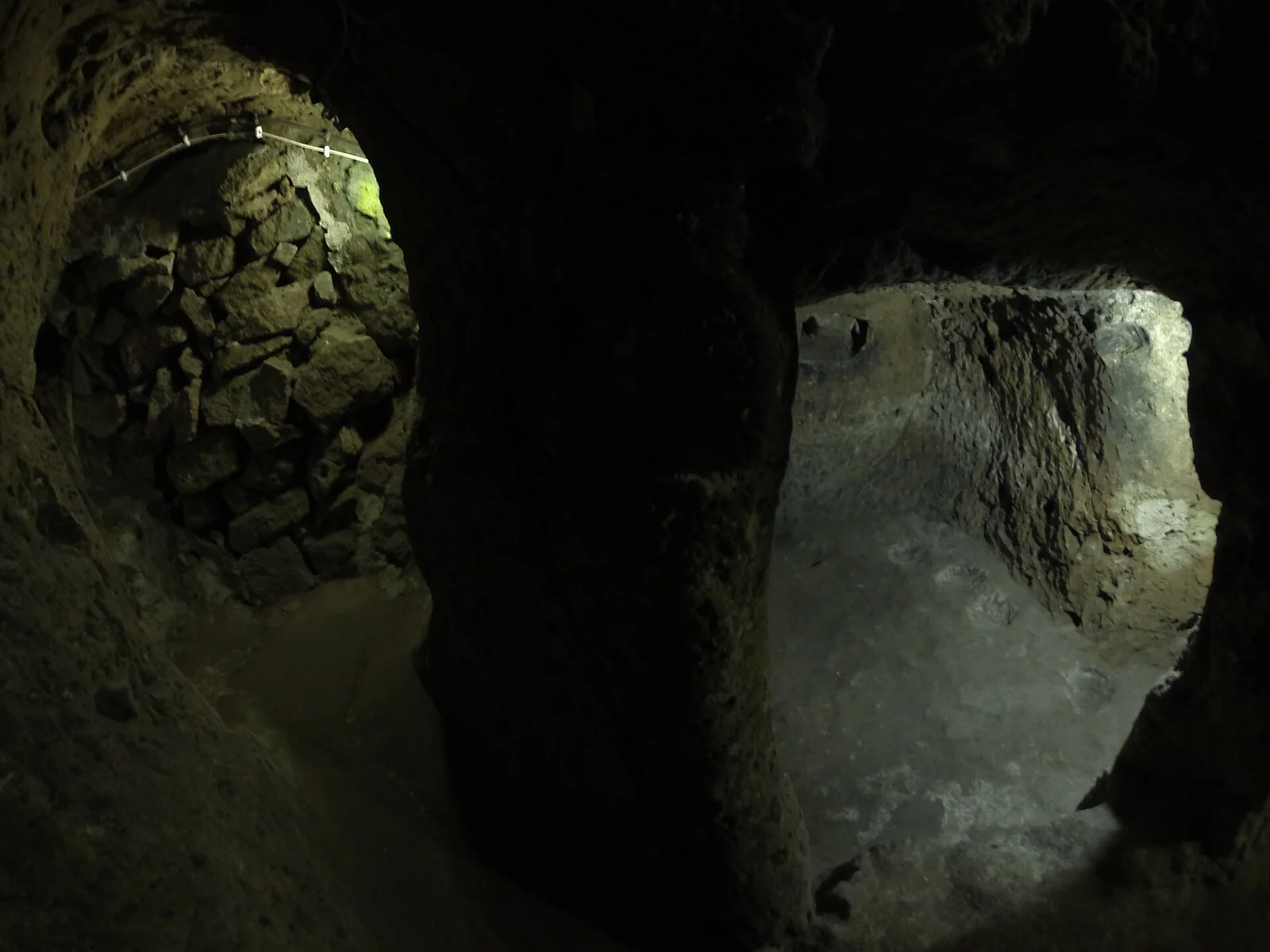
The museum describes narrow passage links and large round stone barriers used to close openings. A narrow controlled link is consistent with regulating entry into a larger space. That relationship supports the refuge account without needing an exact weight or a fictional battle scene.
Do not infer every detail of defence from one door photo. Its form is visible, while its full operation and date need a room-clear record. The museum describes barriers that close from inside; we do not claim a precise crew size or test how the photographed stone moves.
Depth is not a complete defence explanation either. A reported lower well endpoint is different from the rooms where people stayed. The useful questions are how spaces connect, how access could be closed and how daily needs were met, rather than only how low the site extends.
Changes over time
The site may contain cuts and uses from more than one period. The regional heritage record discusses a long rock-cut tradition, and the museum has its own summary of early settlement and refuge. Neither source supplies a single dated plan of every addition.
A first-builder label therefore needs care. A visitor account can name a group. That is not the same as dated finds from each room. If a claim says one group built the entire city, ask which source links that group to the complete network.
Mehmet Özgür Mutlu's geological field study helps identify the rock and wall relationships. It does not resolve every date or historical user. A study of rock answers one set of questions. A study of room use answers another.
Alternative claims and their limits
Popular stories sometimes turn the site's scale into a mystery requiring an unknown technology. A large result is not proof of a strange method. The regional record describes building by removing natural rock, which provides a human physical method for rock-cut space.
That method does not answer every labour question. An exact crew size or work rate needs its own record. So does the time spent cutting the rooms. We leave those details unconfirmed instead of replacing them with a confident guess or an unsupported extraordinary explanation.
Claims about a huge ancient headcount have another limit. Refuge shelter space depends on what space is counted and how long people stay, with water and supplies to match. An estimate is not a record that a fixed group lived full-time in every room.
What this means for a visit
Look for the relationship between room and entrance. Notice how a narrow link differs from the space beyond it. A door, shaft and store each have a task in the museum's explanation. You can read that relationship without accepting a precise population or a single ancient date.
Keep modern lighting and rails separate from ancient features. They make the visitor route usable today. But do not establish original lighting or the full historical movement pattern. A photograph taken on one date is not the current access notice.
Use the public route only. A historic network may include closed areas that once served a purpose in the refuge system. Their appearance on a plan does not authorise a visitor to enter them. Ask about the day's path before relying on a clear room being open.
Frequently asked questions
Was it only a place to hide for a few minutes?
The museum account describes facilities for daily needs, not merely an empty hiding place. That suggests a refuge able to support more than a brief retreat. It does not establish the length of stay of every use. Stores and wells need to be read with evidence for the people and period being discussed.
Does a church prove the entire site is the same age?
No. It can show a religious use of a named space without dating all neighbouring cuts. Rooms may be added or reused. Use the museum's account with its source, and ask what evidence supports a proposed building date. A later function and an original cutting date are different claims.
Continue planning your visit
Verdict: why was Derinkuyu built?
The answer to “why was Derinkuyu built” is strongest at the level of refuge, access control and daily needs. More exact claims about the first builders, every phase or a fixed headcount need their own proof. Sources checked and editorial update: 14 October 2026.