
Derinkuyu Doors: Stone Barriers and Defensive Design
Independent guide; not the museum operator or an official ticket seller.
See how Derinkuyu's round stone barriers relate to narrow passages, with a labelled concept sketch and clear limits on the evidence.
Last updated October 2026
Contents10
- What Derinkuyu doors look like
- How a rolling barrier could close a passage
- Position, openings and control
- What the evidence supports
- Defensive interpretation and its limits
- Reading an annotated photograph
- Seeing Derinkuyu doors on a visit
- Read a barrier together with its passage
- Continue planning your visit
- Verdict on Derinkuyu doors
Derinkuyu doors are round stone barriers set beside narrow rock-cut passages. Their position helps explain the museum's reading of them as closures. A photograph shows the form, while a functional claim needs a source. Exact weights and dates remain separate questions.
What the doors did: The museum describes round stone barriers used to close passages within Derinkuyu. Their form supports a defensive reading. It does not give us a tested weight, an exact date for each stone or proof that every entrance could be sealed at once.
What Derinkuyu doors look like
The most striking feature is the contrast between a large round stone and a small opening. The stone sits in a space cut into the rock beside a passage. In documentary photographs, the round face and the opening can be seen together. This makes the idea of blocking the passage easy to grasp. It does not show the whole mechanism in use.
The Ministry's museum description says that stone cylinders could close narrow passages. That is the main source for the function described here. Source checked October 2026. We have not moved a door, watched a staff demonstration or measured the force needed to close one.
Look at three parts separately: the barrier, the opening and the space alongside it. A picture of the stone alone may hide the last two. The shape of the surrounding rock matters as much as the shape of the round block. It gives room for the block to sit and a narrow place for it to cover.
A door can also be more than one kind of evidence. Its present shape is visible. Its proposed purpose comes from the museum account. Its original date needs a dated study. Those three statements should not be merged into one claim that the image has proved everything about its history.
How a rolling barrier could close a passage
The basic interpretation is simple. A round barrier placed across a narrow opening restricts passage through it. A side recess allows the stone to stand clear of that opening when it is not blocking the way. The sketch below explains that relation. It is a concept drawing, not a measured plan of an actual door chamber.
Do not read the distance between marks as a dimension. Nor does the drawing establish the direction in which a particular photographed door moved. It leaves out floor levels and contact surfaces. Those details would need a measured record of the actual feature. A simple drawing is useful only if its limits are as clear as its labels.
This distinction also applies to animations of the mechanism. A smooth movement in a video is an illustrator's choice unless it comes from a real, documented test. It can explain an idea without proving that the stone moved that way in its original setting. The same caution applies to a model built from a photograph.
Position, openings and control
The museum links the barriers with passages that could be narrow enough for one person. A narrow route and a blocking stone make a strong visual pair. They suggest that access could be limited at a chosen point. They do not tell us how many people guarded it or how long it remained closed during a specific event.
Some photographed stones have an opening in their face. A hole is an observed feature. A claim about what it was used for is a further step. It could require a drawing of the feature, an account of wear or a published interpretation. This guide does not turn the hole into a proved weapon port or a handle without that evidence.
The side from which a stone could be controlled also matters. Many popular accounts say the doors could only be opened from inside. The museum's blocking description supports a refuge interpretation, but it is not a full engineering test of every surviving stone. Before repeating an absolute claim, ask which door was studied and what prevents movement from the other side.
There is a further problem with the word “inside”. A large complex can have several rooms and passages on both sides of a barrier. “Inside the refuge” might mean one part of the site rather than all of it. A map with the barrier marked would make that statement clearer than a loose caption beneath a close-up.
What the evidence supports
| Feature or claim | Evidence used here | Limit of the claim |
|---|---|---|
| Round stone beside a rock-cut opening | Licensed documentary photographs | A still image does not show movement |
| Closing a narrow passage | Ministry museum interpretation | No full functional test is supplied |
| Control from a particular side | Needs a measured study of that door | Not proved for every door here |
| Exact weight or diameter | Needs recorded measurements | No number is given in this guide |
| Date when the stone was made | Needs dated site evidence | Shape alone does not settle it |
| Perfect protection from attack | Would need much broader evidence | Not established by a blocking stone |
Scroll for more →
This table sets a useful standard for a guided explanation. The guide can show you the stone and explain the museum's reading of it. If the account then gives a precise weight, ask for its source. A number repeated on many websites is still one unsupported estimate if none points to a measurement.
The same rule applies to height. A door photographed from below may look much larger than it is. A person standing near it may offer some sense of scale, but only if they stand in the same plane. A wide-angle lens can change the apparent relation. That is why this guide avoids turning photographs into numerical measurements.
Defensive interpretation and its limits
The wider refuge setting makes a blocking door more than an isolated curiosity. UNESCO's account of the Cappadocia rock sites describes underground settlements used for refuge. This is regional context. Together with the museum's account of passage closures, it helps explain the defensive reading of the stones.
It does not name a battle fought at a particular door. Nor does it identify the people who last closed it. A feature built to control movement could be used in several ways over time. The physical form can support an interpretation while leaving the exact event unknown.
It is tempting to describe the complex as a system that could be made fully secure with a few stone doors. That would require much more than seeing one barrier. You would need to know the other entrances, the connected routes and the state of each closure at the same time. A visitor sees only part of the whole site.
The doors also do not solve the question of how long people could remain below ground. Food, water, air and the number of occupants are separate issues. A closed opening cannot supply those answers. Avoid a narrative which moves straight from “the door blocked the passage” to “everyone could live safely here for months”.
Another common claim compares the barrier with a modern vault. That is a poor fit without testing. An ancient carved space and a modern lock have different evidence behind them. The useful point is control of a route. There is no need to add a claim of flawless security to make the design interesting.
Reading an annotated photograph
Start at the opening rather than the centre of the stone. Find the edges of the passage, then the space in which the stone rests. This helps you see why the location matters. A detached view of a round block may make it look like a loose object, while a wider image shows its relation to the route.
Next, look for what the picture leaves out. The far side may be hidden by darkness. A cropped floor may hide the contact point. Modern rails may stand between the camera and the feature. None of these gaps makes the photograph useless, but each limits the account you can build from it.
Finally, read the date and the caption. A photo documents the feature when the image was made. It cannot promise that the same section is open today. A caption which identifies a round stone is safer than one which names its exact date or describes an unrecorded siege.
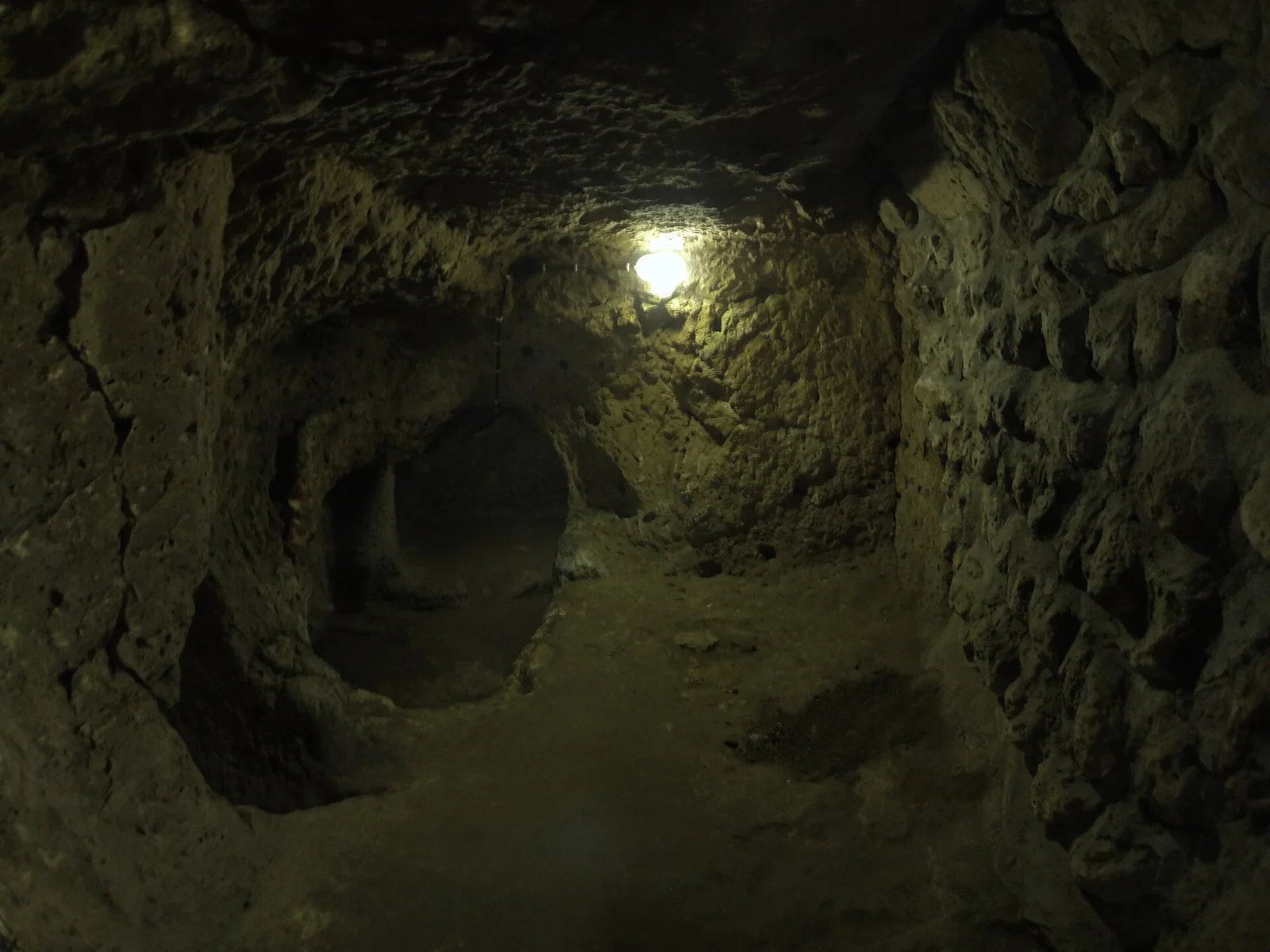
Our documentary hero is credited below the image. It shows a stone feature within Derinkuyu. The credit identifies the photographer and licence; it is not an archaeological report. The door's proposed function is sourced separately in the text. That keeps the photographic record and the historical interpretation clear.
Seeing Derinkuyu doors on a visit
Ask museum staff which stone-door features are on the current public route. Sections can be managed differently from the full documented site. A picture in a guide should never be treated as permission to enter a side opening, cross a rail or move an object. Follow the marked visitor route and the staff's directions.
If you book a guide, ask whether the explanation includes the doors and how much time is allowed inside. A named Derinkuyu stop is more useful than a generic promise of “an underground city”. The latter may refer to a different site. The guide should also be able to separate the museum's interpretation from facts they have measured themselves.
For photographs, wait for a clear view without blocking a tight passage. Do not rely on touching the stone to understand its scale. A wider view which includes the nearby opening can be more informative than a close-up. Respect any signs about photography and the directions of the staff on the day.
Questions worth asking
- Which feature is this, and where does it appear on the museum plan?
- Is its proposed function stated by the museum or by a separate study?
- Is a quoted size measured, estimated or repeated from another guide?
- Does the explanation describe this particular stone or doors in general?
- Which part of the current route can visitors see without leaving it?
These questions invite a more precise account. They need not turn the visit into a debate. A guide who says “the museum interprets this as a passage closure” has given a useful answer. They have also left room for the limits of the evidence.
Read a barrier together with its passage
The Ministry's Derinkuyu description places large stone cylinders at tunnel entrances and exits. It describes their role as closing the tunnel for security. That is a claim about the barrier within a passage, rather than a claim that a loose stone protected every room. Source checked October 2026.
When looking at a door photograph, first find the passage edge. Then look for the stone's position beside that edge. A close crop can show the disc clearly while hiding the space in which it moved. Without that setting, even a sharp image can leave the mechanism unclear. A wider view can be more useful than a dramatic close-up.
Next, separate what the image shows from what the museum explains. The disc's outline may be visible. Its full movement, the force needed and the way it was controlled may not be. Those further details need a source or a documented demonstration. A modern visitor should not try to move a barrier to settle the question.
This gives you a simple way to discuss the feature with a guide: identify the passage, identify the barrier, then ask how the closing action is documented. Keep any modern supports or rails separate from the ancient mechanism. The result is a useful explanation of one door setting without inventing a weight or a successful siege story.
Continue planning your visit
Verdict on Derinkuyu doors
Derinkuyu doors are best understood as barriers for controlling narrow passages, following the museum's interpretation. Their position is central to that explanation. Treat exact weights, dates and claims of perfect security as separate questions which need separate proof.