
Derinkuyu in Numbers: 40 Facts (2026)
Historical museum entries, dated site research and Cappadocia records. Download the visitor data and follow each original source.
Overall depth is not visitor descent; described levels are not today's open-route count. Entries count admissions, not unique people. Sources: Ministry brochure, Ministry venue record and provincial workbook.
Historical reference dataset below: museum entries, not unique visitors, from the undated provincial workbook, retrieved October 2026. Changes are our calculations. The selected complete years are 2014–2019; the workbook’s 2020 sheet is incomplete.
Entries · scale 0–500,000
| 2019 | 459,734 | 633,248 | +20.4% |
|---|---|---|---|
| 2018 | 381,826 | 532,396 | +27.6% |
| 2017 | 299,282 | 318,030 | +4.7% |
| 2016 | 285,885 | 43,115* | -32.2% |
| 2015 | 421,456 | 413,278 | +0.2% |
| 2014 | 420,690 | 466,228 | Not available |
* Kaymaklı 2016: as published in the provincial workbook; the source gives no reason (monthly figures are low throughout 2016).
No year matches. Clear the search or select Reset to show the six recorded years.
Key takeaways
- The Ministry’s September 2019 brochure described Derinkuyu Underground City as approximately 85 metres deep, an overall-site estimate rather than a measured visitor descent. (Ministry of Culture and Tourism, September 2019)
- The Ministry of Culture and Tourism describes Derinkuyu Underground City as having 8 levels; this is a site description, not the number open today. (Ministry of Culture and Tourism, accessed October 2026)
- The Ministry’s September 2019 brochure estimated that 10 percent of Derinkuyu Underground City could then be visited; it did not establish today’s open route. (Ministry of Culture and Tourism, September 2019)
- The Ministry’s September 2019 brochure described Derinkuyu’s ventilation shaft, also used as a well, as 55 metres deep. (Ministry of Culture and Tourism, September 2019)
- The provincial workbook records 459,734 museum entries at Derinkuyu in 2019, compared with 633,248 at Kaymaklı; these are admissions, not unique people. (Nevşehir Provincial Culture and Tourism Directorate, accessed October 2026)
- The Ministry’s September 2019 brochure estimated 150–200 underground settlements of various sizes in the Cappadocia region, rather than that many visitable museums. (Ministry of Culture and Tourism, September 2019)
How many visits did Derinkuyu record?
Historical museum entries, not unique people or present-day crowd forecasts. This undated workbook is retained as a reference dataset; its publication month is unknown.
| Lowest year | Highest year | Interpretation |
|---|---|---|
| 2016: 285,885 entries | 2019: 459,734 entries | Historical variation, not a quiet-day ranking |
Reference context: Nevşehir Provincial Culture and Tourism Directorate. Publication month not supplied; retrieved October 2026.
- The provincial workbook records 459,734 museum entries at Derinkuyu in 2019, compared with 633,248 at Kaymaklı; these are admissions, not unique people. (Nevşehir Provincial Culture and Tourism Directorate, accessed October 2026)
How many levels are described, and what was measured?
The current undated Ministry record describes Derinkuyu as an eight-level site. Levels, shaft depth and geological thickness measure different things; none establishes today’s open route.
| Measure | Figure | Scope |
|---|---|---|
| Derinkuyu site | 8 levels | Ministry description; open-route count not stated |
| Kaymaklı site | 8 levels | Ministry site description |
| Kaymaklı visitor account | 4 lit levels | Check the route in use today |
| Derinkuyu research sample | 46 rooms | Mutlu, May 2008 |
| Kaymaklı research sample | 64 rooms | Mutlu, May 2008 |
| Derinkuyu probable thickness | 40 m | Geological interpretation |
| Kaymaklı probable thickness | 25 m | Geological interpretation |
| Kızılkaya field outcrop | 13.5 m | Observed rock-unit thickness |
| Gördeles field outcrop | 34 m | Observed rock-unit thickness |
| Derinkuyu overall depth estimate | Approximately 85 m | Ministry brochure, September 2019; not visitor descent |
| Ventilation shaft / well | 55 m | Ministry brochure, September 2019 |
| Then-visitable share | 10 percent | Ministry brochure, September 2019; historical estimate |
| Regional underground settlements | 150–200 | Ministry brochure estimate; not a museum count |
Reference context: Ministry of Culture and Tourism; Ministry of Culture and Tourism. Publication month not supplied; retrieved October 2026.
- The Ministry’s September 2019 brochure described Derinkuyu Underground City as approximately 85 metres deep, an overall-site estimate rather than a measured visitor descent. (Ministry of Culture and Tourism, September 2019)
- The Ministry’s September 2019 brochure described Derinkuyu’s ventilation shaft, also used as a well, as 55 metres deep. (Ministry of Culture and Tourism, September 2019)
- The Ministry’s September 2019 brochure estimated that 10 percent of Derinkuyu Underground City could then be visited; it did not establish today’s open route. (Ministry of Culture and Tourism, September 2019)
- The Ministry’s September 2019 brochure estimated 150–200 underground settlements of various sizes in the Cappadocia region, rather than that many visitable museums. (Ministry of Culture and Tourism, September 2019)
- Mutlu's Cappadocia geological study interpreted Derinkuyu's probable complex thickness as 40 metres, distinct from a well endpoint or visitor descent. (Mehmet Özgür Mutlu, METU, May 2008)
- Mutlu's Cappadocia geological study interpreted Kaymaklı's probable complex thickness as 25 metres, distinct from the length of its visitor walk. (Mehmet Özgür Mutlu, METU, May 2008)
- Mutlu's field study observed a Kızılkaya ignimbrite thickness of 13.5 metres at the outcrop studied, not the depth of Derinkuyu Underground City. (Mehmet Özgür Mutlu, METU, May 2008)
- Mutlu's field study observed a Gördeles ignimbrite thickness of 34 metres at the outcrop studied, not the depth of Kaymaklı Underground City. (Mehmet Özgür Mutlu, METU, May 2008)
- The Ministry of Culture and Tourism describes Derinkuyu Underground City as having 8 levels; this is a site description, not the number open today. (Ministry of Culture and Tourism, accessed October 2026)
For the route and room labels, use our Derinkuyu level reference. For the choice between the museums, use Kaymaklı vs Derinkuyu.
How large were the rooms and narrow passages surveyed?
These are particular spaces documented by Okuyucu in 2007. Her floor labels are retained; different publications number levels differently. Measurements are historical, not minimum clearances for today’s public route.
| Measure | Figure | Scope |
|---|---|---|
| Main stable | About 19.50 m long; 3.00–7.00 m wide | 2007 survey, printed p.516 |
| Smaller stable room | 8.10 × 4.10 m | 2007 survey, printed p.516 |
| School corridor | 15.40 m long | 2007 survey, printed p.517 |
| School width | 4.40 m | 2007 survey, printed p.517 |
| Second-level kitchen | About 6.00 × 4.00 m | 2007 survey, printed p.517 |
| Tandır oven | 0.70 m diameter | 2007 survey, printed p.517 |
| Passage toward stores | 5.40 m long; about 0.60 m wide; 1.30 m high | 2007 survey, printed p.517; not current clearance |
| Fifth-to-seventh-level tunnel | 46.00 m long | 2007 survey, printed p.519 |
| Well opening | 0.90 × 0.95 m | 2007 survey, printed p.519; not depth |
| Experimental horizontal reconstruction | 2 floor plans | Şenel, June 2024; model, not visitor map |
- Okuyucu’s 2007 Derinkuyu survey described the main stable as approximately 19.50 metres long and 3.00–7.00 metres wide. (Demet Okuyucu, Atatürk University, September 2007)
- Okuyucu’s 2007 Derinkuyu survey gave the stable’s smaller connected room dimensions of 8.10 by 4.10 metres. (Demet Okuyucu, Atatürk University, September 2007)
- Okuyucu’s 2007 Derinkuyu survey measured the corridor from the stable toward the missionary school at 15.40 metres long. (Demet Okuyucu, Atatürk University, September 2007)
- Okuyucu’s 2007 Derinkuyu survey gave the missionary school a width of 4.40 metres, with unequal north and south wall lengths. (Demet Okuyucu, Atatürk University, September 2007)
- Okuyucu’s 2007 Derinkuyu survey described the second-level kitchen as approximately 6.00 by 4.00 metres. (Demet Okuyucu, Atatürk University, September 2007)
- Okuyucu’s 2007 Derinkuyu survey gave the tandır oven in the second-level kitchen a diameter of 0.70 metres. (Demet Okuyucu, Atatürk University, September 2007)
- Okuyucu’s 2007 Derinkuyu survey described the passage toward the second-level stores as 5.40 metres long, approximately 0.60 metres wide and 1.30 metres high; those measurements do not guarantee a current visitor clearance. (Demet Okuyucu, Atatürk University, September 2007)
- Okuyucu’s 2007 Derinkuyu survey described the tunnel connecting her fifth and seventh levels as 46.00 metres long. (Demet Okuyucu, Atatürk University, September 2007)
- Okuyucu’s 2007 Derinkuyu survey measured the rectangular seventh-level well opening at 0.90 by 0.95 metres, not its depth. (Demet Okuyucu, Atatürk University, September 2007)
- Şenel’s 2024 experimental Derinkuyu reconstruction combined 2 floor plans, preserving their links while modelling the vertical arrangement horizontally rather than producing a visitor map. (Kübra Yılmaz Şenel, Istanbul Esenyurt University, June 2024)
Which heritage figures apply to the whole landscape?
The UNESCO area includes several places. The church date below refers to a separate above-ground building in Derinkuyu.
| Measure | Figure | Scope |
|---|---|---|
| World Heritage inscription | 1985 | Whole serial property |
| World Heritage area | 9,883.81 ha | Whole serial property |
| Church inscription | 15 May 1858 | Above-ground Agios Theodoros Trion |
| ICOMOS recommendation | 3 cultural criteria: (i), (iii), (v) | July 1985; advisory stage |
Reference context: UNESCO World Heritage Centre; Derinkuyu Municipality. Publication month not supplied; retrieved October 2026.
- Göreme National Park and the Rock Sites of Cappadocia entered the World Heritage List in 1985, as recorded in the Committee’s December 1985 inscription report. (UNESCO World Heritage Committee, December 1985)
- ICOMOS recommended Göreme and Cappadocia for inscription under 3 cultural criteria in July 1985: (i), (iii) and (v); this was the advisory recommendation, not the final mixed-property decision. (ICOMOS, July 1985)
How far is Derinkuyu from nearby cities?
The district’s rounded distances are useful for orientation. They do not specify a start address, driving time or airport transfer.
| Measure | Figure | Scope |
|---|---|---|
| Derinkuyu to Nevşehir | 30 km | Rounded town distance |
| Derinkuyu to Niğde | 50 km | Rounded town distance |
| Derinkuyu to Kayseri | 110 km | Rounded town distance |
| Derinkuyu to Aksaray | 80 km | Rounded town distance |
| District area | 445 km² | Surface district, not excavation |
Reference context: Derinkuyu District Governorate. Publication month not supplied; retrieved October 2026.
What do Nevşehir’s climate normals show?
The table preserves Nevşehir station averages for 1981–2010 from an undated source. The separate 2025 observation below covers Central Anatolia against 1991–2020 normals. Neither measures temperatures inside Derinkuyu.
| Month | Mean | Average low | Average high |
|---|---|---|---|
| Jan | 0.0 | -3.5 | 4.1 |
| Feb | 1.3 | -2.6 | 6.0 |
| Mar | 5.5 | 1.0 | 10.9 |
| Apr | 10.4 | 5.2 | 16.3 |
| May | 15.0 | 9.3 | 21.2 |
| Jun | 18.9 | 12.3 | 25.6 |
| Jul | 22.2 | 14.6 | 29.3 |
| Aug | 22.1 | 14.5 | 29.4 |
| Sep | 18.1 | 11.3 | 25.3 |
| Oct | 12.8 | 7.4 | 19.1 |
| Nov | 6.3 | 2.1 | 11.6 |
| Dec | 2.0 | -1.4 | 6.2 |
Reference context: Turkish State Meteorological Service. Publication month not supplied; retrieved October 2026.
- Central Anatolia’s monthly mean temperatures were below their 1991–2020 normals in 2 months of 2025, February and April, counted from the meteorological service’s named months; this is regional outdoor context, not an underground temperature. (Turkish State Meteorological Service, February 2026)
What do Cappadocia’s balloon records actually count?
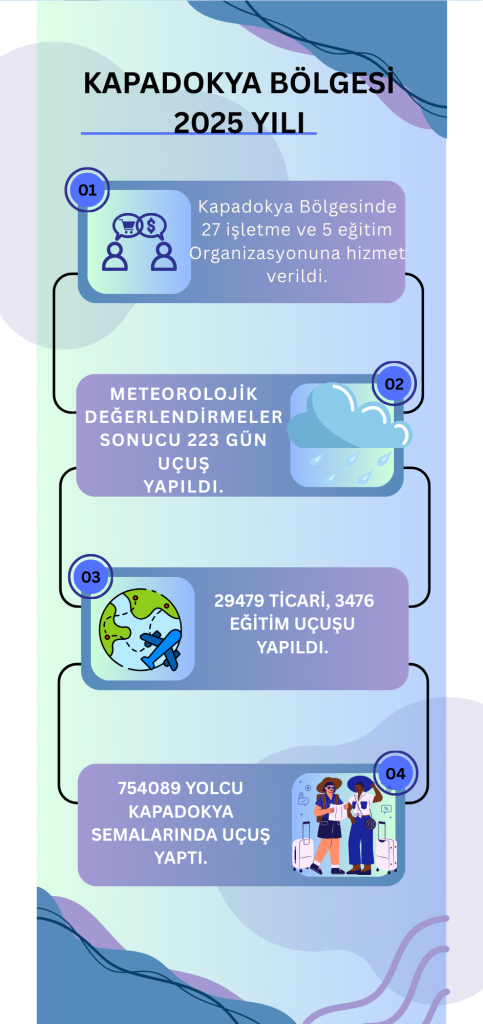
The slot-service records separate commercial flying from training. The 2025 panel covers a calendar year; the older table covers September 2022–August 2023. We do not calculate a year-on-year change between them or a future flight probability.
| Measure | Figure | Scope |
|---|---|---|
| Commercial operators served | 27 | Cappadocia region, 2025 |
| Training organisations served | 5 | Cappadocia region, 2025 |
| Days with flying | 223 | Not a forecast or cancellation probability |
| Commercial flights | 29,479 | Cappadocia region, 2025 |
| Training flights | 3,476 | Separate from commercial flights |
| Balloon passenger rides | 754,089 | Cappadocia region, calendar year 2025 |
| Days with flying | 225 | Cappadocia, 1 Sep 2022–31 Aug 2023 |
| Actual commercial flights | 28,540 | Cappadocia, 1 Sep 2022–31 Aug 2023 |
| Actual training / practice flights | 4,946 | Cappadocia, 1 Sep 2022–31 Aug 2023 |
| Balloon passenger rides | 625,718 | Cappadocia, 1 Sep 2022–31 Aug 2023 |
- Kapadokya University’s slot service reported serving 27 commercial balloon operators in the Cappadocia region in 2025. (Kapadokya University, January 2026)
- Kapadokya University’s slot service reported serving 5 balloon training organisations in the Cappadocia region in 2025. (Kapadokya University, January 2026)
- Kapadokya University reported balloon flying on 223 days in the Cappadocia region during 2025 following meteorological assessments. (Kapadokya University, January 2026)
- Kapadokya University recorded 29,479 commercial balloon flights in the Cappadocia region during 2025. (Kapadokya University, January 2026)
- Kapadokya University recorded 3,476 balloon training flights in the Cappadocia region during 2025. (Kapadokya University, January 2026)
- Kapadokya University recorded 754,089 balloon passenger rides in the Cappadocia region in calendar year 2025; this is not a unique-person count. (Kapadokya University, January 2026)
- Kapadokya University recorded balloon flying on 225 days in its Cappadocia flight region between 1 September 2022 and 31 August 2023, rather than calendar year 2023. (Kapadokya University, November 2023)
- Kapadokya University recorded 28,540 actual commercial balloon flights in its Cappadocia flight region between 1 September 2022 and 31 August 2023, excluding planned-but-unflown slots. (Kapadokya University, November 2023)
- Kapadokya University recorded 4,946 actual training or practice balloon flights in its Cappadocia flight region between 1 September 2022 and 31 August 2023, separately from commercial flights. (Kapadokya University, November 2023)
- Kapadokya University recorded 625,718 balloon passenger rides in its Cappadocia flight region between 1 September 2022 and 31 August 2023; this is not a calendar-year or unique-person total. (Kapadokya University, November 2023)
Why are national balloon totals different?
The aviation regulator covers several Turkish flight regions. Its national activity report and the university release are separate series and are not combined here.
| Measure | Figure | Scope |
|---|---|---|
| Balloon operators | 71 | Regulator’s Turkish regions, 2025 |
| Balloons | 517 | Regulator’s Turkish regions, 2025 |
| Balloon flights | 41,536 | Regulator’s Turkish regions, 2025 |
- Türkiye’s aviation regulator reported 71 balloon operators across the Turkish regions covered by its 2025 activity report, not Cappadocia alone. (Directorate General of Civil Aviation, March 2026)
- Türkiye’s aviation regulator reported 517 balloons across the Turkish regions covered by its 2025 activity report, not Cappadocia alone. (Directorate General of Civil Aviation, March 2026)
- Türkiye’s aviation regulator reported 41,536 balloon flights across the Turkish regions covered by its 2025 activity report, not Cappadocia alone. (Directorate General of Civil Aviation, March 2026)
The university’s national commercial-flight series and the regulator’s balloon-flight series do not match. Their coverage is not reconciled, so we do not calculate Cappadocia’s share from those totals.
Which airport figures help frame the onward trip?
Airport infrastructure and town distances are separate from a museum transfer. Kayseri’s figures below describe the 2024 terminal project.
| Measure | Figure | Scope |
|---|---|---|
| Nevşehir airport to Nevşehir city | 30 km | Operator distance; not to Derinkuyu |
| Nevşehir airport opened | 1998 | Operator record |
| Kayseri terminal project area | 51,000 m² | January 2024 announcement |
| Kayseri boarding bridges | 6 | January 2024 announcement |
| Kapadokya airport commercial flights | 4,556 | By 30 December 2025; different aircraft scope |
| Kapadokya airport passenger growth | 7 percent | Same-period comparison in operator’s 2025 snapshot |
Reference context: DHMİ; DHMİ. Publication month not supplied; retrieved October 2026.
- The Transport Ministry’s Kayseri Airport project announcement described a terminal area of 51 thousand square metres in January 2024. (Ministry of Transport and Infrastructure, January 2024)
- The Transport Ministry’s Kayseri Airport project announcement specified 6 passenger boarding bridges in January 2024. (Ministry of Transport and Infrastructure, January 2024)
- Nevşehir Kapadokya Airport had served 4,556 commercial flights by 30 December 2025 in the operator’s snapshot; these are not all aircraft movements. (DHMİ, January 2026)
- Nevşehir Kapadokya Airport’s operator reported passenger growth of 7 percent by 30 December 2025 against the same period of 2024; the release does not give the comparison-period passenger count. (DHMİ, January 2026)
For the next leg, see airport transfer choices. The airport-to-city distance above cannot be added to a town distance to make a checked through-route.
Methods and limitations
We checked 75 candidate figures and kept 40 as sourced statistic sentences. Each retained sentence has a publication month from its original document, official publication record or PDF creation metadata. The Ministry brochure uses its September 2019 PDF date and the aviation report its March 2026 PDF date; the university’s 2022–2023 report uses its November 2023 PDF date. We retained verified figures without a publication month only as linked reference tables or notes, labelled retrieved October 2026; these are outside the forty-statistic count and key takeaways. We excluded untraced totals, an unsupported population estimate, a fixed visitor descent and conflicting opening-year and balloon figures. All original sources were accessed on 16 October 2026.
Our museum compilation reads the Derinkuyu and Kaymaklı rows in the workbook’s 2014–2019 sheets. Each annual total equals the sum of its twelve monthly cells. The CSV retains source rows and links; percentage changes compare consecutive calendar years and round to one decimal. The 2014 change stays unavailable within this selected series. We excluded the incomplete 2020 sheet and did not fill blanks with zero. Museum entries can include the same person at more than one venue.
Station climate normals describe Nevşehir outdoors; the regional 2025 climate observation uses a different baseline. Historical room measurements and experimental floor-plan models are not present-day accessibility assessments. Geological estimates, museum level counts, airport infrastructure and flight activity have separate definitions. They are not combined into a visitor-capacity score. Historic data is retained as historic data. Next review: , sooner if an official correction arrives. Send a correction with the figure and original source.
Cite this page: Derinkuyu Underground City. “40 Derinkuyu and Cappadocia Facts and Figures (2026).” Updated 16 October 2026. https://derinkuyuundergroundcity.com/history/derinkuyu-facts-and-figures/
Sources
- Nevşehir Provincial Culture and Tourism Directorate. Undated provincial workbook. Sheets 2014–2019; the incomplete 2020 sheet is excluded. Retrieved October 2026.
- Ministry of Culture and Tourism. Undated Kaymaklı venue record. Retrieved October 2026.
- Turkish State Meteorological Service. Nevşehir station climate normals for 1981–2010; undated table. Retrieved October 2026.
- Mehmet Özgür Mutlu, METU. Abstract, printed page iv. Original field study; probable thickness is an interpretation, not visitor descent.
- UNESCO World Heritage Centre. Undated official property record; area covers the whole serial property. Retrieved October 2026.
- Derinkuyu District Governorate. Undated geographic description. Rounded town-to-city distances, not hotel or airport transfers. Retrieved October 2026.
- Derinkuyu Municipality. Municipal transcription of the above-ground church inscription; undated page. Retrieved October 2026.
- DHMİ. Undated operator record: distance to Nevşehir city, not to Derinkuyu. Retrieved October 2026.
- DHMİ. Undated airport operator record. Retrieved October 2026.
- Kapadokya University. Cappadocia 2025 infographic in the university’s 6 January 2026 annual release. Original slot-service observations; passenger rides are not necessarily unique people.
- Directorate General of Civil Aviation. 2025 activity report, printed page 66, section 4.6. PDF created March 2026; national coverage, separate from the university’s Cappadocia series.
- Ministry of Transport and Infrastructure. 22 January 2024 project announcement for Kayseri airport; infrastructure figures, not passenger totals.
- Ministry of Culture and Tourism. Undated Derinkuyu venue record; described levels are not a current open-route count. Retrieved October 2026.
- Ministry of Culture and Tourism. Derinkuyu brochure, PDF created September 2019. Historical descriptions and estimates; not a statement of the route open today.
- Demet Okuyucu, Atatürk University. Original architectural account, symposium of 27–29 September 2007, printed pages 516–519. Measurements describe particular rooms and passages in that study, not guaranteed current visitor clearances.
- UNESCO World Heritage Committee. Report of the Rapporteur, SC-85/CONF.008/9, dated December 1985 on its cover; the inscription entry is on printed page 11.
- ICOMOS. ICOMOS evaluation closes with July 1985. Its three cultural criteria are the recommendation, distinct from the final mixed inscription.
- Turkish State Meteorological Service. 2025 climate assessment, cover dated February 2026, section 2.3.4, printed page 11. Central Anatolia is a region, not a Derinkuyu indoor reading.
- DHMİ. Operator release dated 1 January 2026, reporting the position at 30 December 2025. This is a partial-year snapshot, not the final 2025 annual total.
- Kübra Yılmaz Şenel, Istanbul Esenyurt University. Original space-syntax research, published 30 June 2024 on the paper’s first page. The two-floor horizontal reconstruction is an experiment, not an excavated route or visitor map.
- Kapadokya University. 2022–2023 annual activity report, first-page flight table, PDF created November 2023. Period: 1 September 2022–31 August 2023, not calendar year 2023. Actual flights, not planned slots.