
Derinkuyu Lighting: Historical Evidence and Modern Illumination
Independent guide; not the museum operator or an official ticket seller.
Separate ancient lighting questions from modern visitor lights at Derinkuyu, with source tests for lamp, niche and soot claims.
Last updated October 2026
Contents9
Derinkuyu lighting raises two different questions: how people lit the spaces during earlier use, and how visitors see them today. Modern lights are visible in dated photos. A site-specific list of ancient lamps, fuels or dated soot deposits was not located for this guide. We do not turn that gap into a claim of an ancient electrical system.
The present visitor lights do not reveal the ancient lighting method. A lamp, niche or dark mark would need a recorded context before it could answer that question. Surface openings may admit light nearby, but that does not show light throughout the rooms. The historical model remains limited by the evidence available here.
Derinkuyu lighting: what is known
The Ministry's Derinkuyu description names rooms, passages, shafts and wells. Its short visitor account is useful for the museum's reading of the site. It does not supply a catalogue of excavated lamps with find locations. Source checked October 2026. That limits the historical lighting answer we can give.
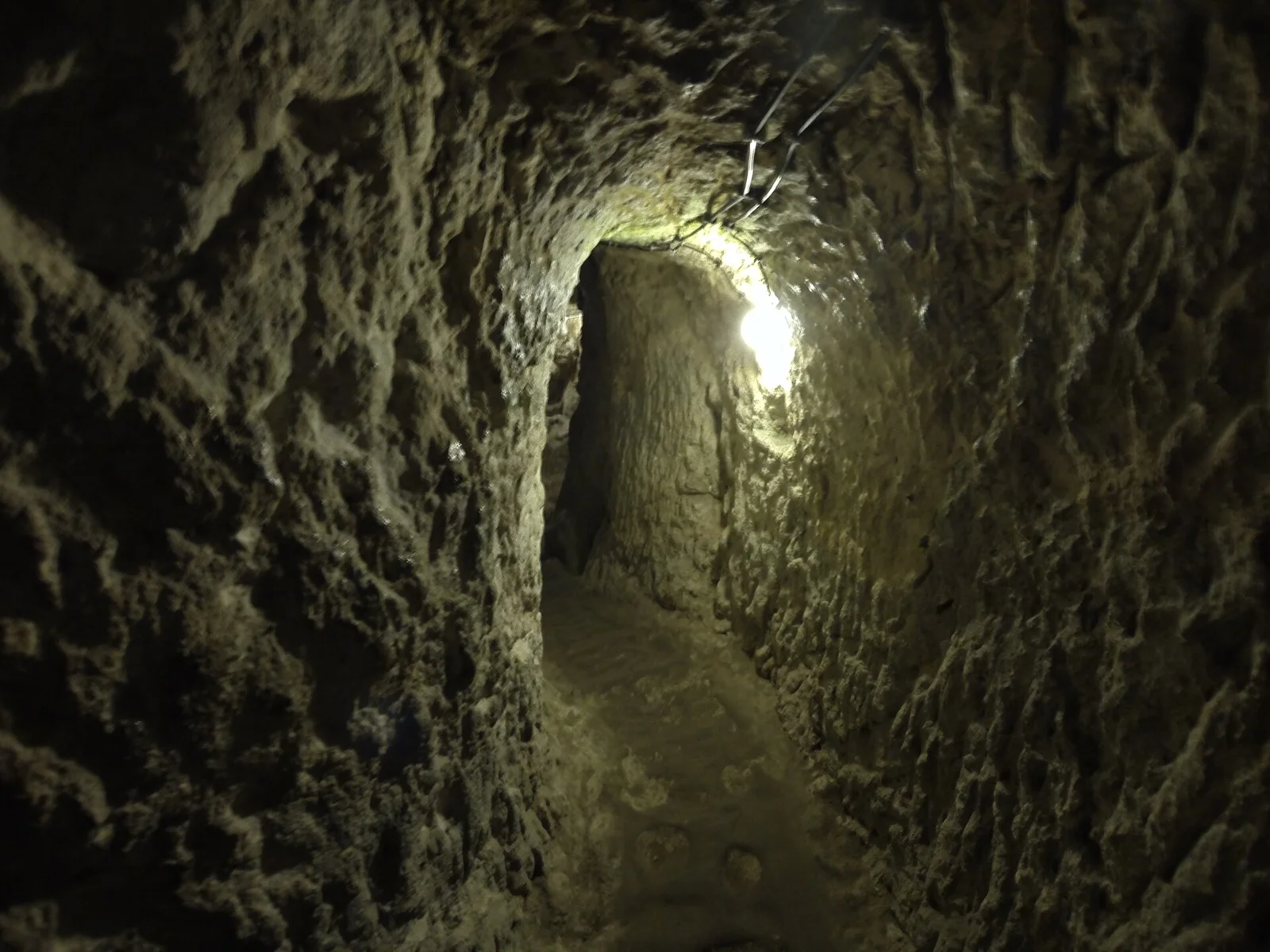
There are photos of the site with electric fittings and lit visitor passages. These show the state of the museum when the images were made. They are not evidence that the lights were present during ancient use. A modern fitting beside an old wall belongs to the visitor setting, rather than to the original cutting of the room.
That distinction should also be kept in captions. “Lit passage at Derinkuyu” describes what a photo shows. “Ancient lamp-lit passage” adds a claim about a past light source. Without evidence for that source, the second caption is more than the image can support.
This guide's hero is a dated view of a Derinkuyu passage. It is not a simulation of ancient lighting. The photographer's credit and licence appear under it. The image can help you read the space, but it cannot provide a history of the fittings or name the lights used by earlier occupants.
Lamps, niches and soot evidence
A secure lamp find would be useful evidence. The record should name the object, where it was found and the context in which it was recovered. A drawing or photo could show its form. A dated study could then explain how that find relates to the use of the room. We have not located that full chain for a Derinkuyu lighting claim.
A recess in a wall may prompt the idea that it held a lamp. That is a possible account to investigate. Its shape alone does not prove the function. A measured description, a associated object or a study of use traces could strengthen the case. A visitor's guess based on a convenient shelf is not the same kind of evidence.
Dark marks require similar care. A photo can show a dark patch without proving what caused it. Shadow, moisture, surface material and the way an image is exposed can change its appearance. To call it soot from a given light source, a study would need to examine the material and its context.
The absence of visible soot in a photo is even harder to use. The camera may not show all the surfaces. The image may be brightened or taken from an angle which hides a mark. A clean-looking wall in one shot cannot prove that no fire-based light was ever used anywhere in the site.
What each trace would need
| Observed feature | Possible question | Evidence needed |
|---|---|---|
| Small wall recess | Was it used to support a lamp? | Recorded context and a supported functional account |
| Dark surface mark | Is it soot, and from what source? | Material study and location record |
| Portable object named as a lamp | When and where was it used? | Find record, dating method and context |
| Light entering an opening | Which nearby surfaces receive it? | Location and observation conditions |
| Electric fitting | What does the visitor setting look like? | Dated dated record, not an ancient account |
Scroll for more →
The table is a guide to reading evidence, not a claim that each item has been found here. It keeps an observation separate from the question it might answer. That separation is useful when a guide points at a mark or a niche and gives a confident historical label.
What light could reach from the surface
A surface opening can admit daylight. Whether that light reaches a given room depends on the opening's position and the route between them. A straight shaft is not the same as a bent passage. A room behind a turn may have a quite different view of the surface from a room beside an entrance.
This is a geometric point, not a measured lighting survey of Derinkuyu. We do not give a distance at which daylight stops, or a light level for a named chamber. To make those claims, a study would need to name the openings and measure the conditions at the useful points.
The time and weather would also need to be recorded. A surface opening observed under one set of conditions cannot show the light in all seasons or at all hours. Nor can a photo taken with electric lights on show how the same room would look with daylight alone.
Be cautious with the idea that ventilation shafts must have lit the whole site. A shaft can have an air function without giving each room a direct view of the sky. The layout needs to be examined before one function is turned into another. The museum's shaft account does not supply a room-by-room daylight study.
If an illustration sends a bright beam down every passage, read it as a visual choice unless the geometry is sourced. A beam can make a cutaway easier to understand. It does not prove the level of light available in a real room. The purpose of an explanatory graphic should be stated beside it.
Limits of model
Reconstructing historical lighting requires more than selecting a plausible lamp. It requires evidence that this kind of light source was used at this site, in the useful period and setting. A lamp known from another place may help form a question. It cannot automatically answer the Derinkuyu question.
The same applies to fuel. This guide does not name an ancient fuel, calculate how much was burned or estimate how long a room could be lit. Such a calculation would need a light source, fuel type, usage pattern and a stated method. An unsupported number would give a false impression of precision.
Ventilation makes the question more complex, but it does not close the evidence gap. To link a flame with a room's air conditions, a study would need more than the presence of a shaft. We do not use a historic refuge account as a current air-quality guarantee or as proof of the conditions under ancient lighting.
Nor does the lack of a located lamp list support a claim of lost electrical technology. That would require positive evidence for the proposed system. An unanswered question about light cannot be used as proof of a much larger claim. The responsible answer can remain incomplete.
There is value in a clearly labelled model. A drawing could show what a room might look like under a proposed light source. Its caption should say that the light is imagined. It should also state the evidence behind the proposal. A realistic image without that label can make an account look like a record.
Modern visitor lighting
Modern fittings help visitors read the route, but their presence in an older photo does not show current conditions. The image has a capture date. The museum's present signs and staff directions are the right guide during the visit. We do not promise the brightness of each passage from a picture taken years ago.
If low light is a concern, ask the venue about the route in use. Describe what you need to know in practical terms. Ask whether there are dark transitions, steps or narrow areas on that route. A broad question about whether the entire city is “well lit” may produce an answer too vague for your decision.
Do not use a personal light or camera flash in a way that ignores staff instructions. Check the rules for the day. A light aimed at another person in a tight passage can affect their view. Moving aside safely and following the route matters more than obtaining a given photo.
The lighting of a visitor route also has a different purpose from lighting a lived-in room. A modern fitting may emphasise an edge, a sign or the way through. It should not be used to infer where earlier occupants cooked, worked or slept. Those activities need their own archaeological support.
Reading a photo of a dark space
A camera can make a dark interior look brighter than it seemed to a person. Exposure and later edits affect the result. A bright photo is therefore not a light-level measurement. It can show features clearly while still leaving the actual conditions of capture uncertain.
Colour can also mislead. A warm-looking light may be a modern fitting or a choice made in editing. It does not name an ancient flame. A blue or white cast does not prove a given lamp type. Keep the visual effect separate from the history of the light source.
Look for clues which the image can support directly. A cable, housing or fitting can document a modern feature. A visible patch of light can show how the scene appeared to the camera. A missing area in deep shadow remains unseen; it should not be filled in with a confident claim about the wall behind it.
Finally, look at the creator's description and date. A photo labelled only as Derinkuyu may not name the room. It cannot be used as a map of all visitor lighting. It is one view of one place at one time, useful within those limits.
Questions and source notes
For a historical explanation
- Ask whether a lamp claim comes from a find record or from a general model.
- Ask which room or surface the evidence concerns.
- Ask how the proposed date was reached.
- Ask whether a niche's purpose is shown or interpreted.
- Ask whether a dark mark was examined, rather than named from its appearance.
For planning your visit
- Check the current route and its lighting with the museum.
- Ask about the features which matter to your own visit, such as steps and changes in light.
- Follow the venue's rules on personal lights and photography.
- Treat older photos as dated views, not current access notices.
The official museum description is the source for the site's public feature account. The photos provide a separate record of visible spaces. Neither source, as consulted here, supplies a dated list of ancient lighting objects. That is the specific gap behind the historical answer.
Continue planning your visit
Verdict on Derinkuyu lighting
Derinkuyu lighting today is visible in the museum's dated record. The earlier method remains a separate research question. Read lamps, niches and soot claims through their recorded contexts, and avoid treating either modern lights or a lack of located evidence as proof of an ancient system.