
Derinkuyu Water: Wells, Supply and Uncertain Claims
Independent guide; not the museum operator or an official ticket seller.
Read Derinkuyu's wells and water-supply interpretations separately from ventilation, capacity estimates and present water quality.
Last updated October 2026
Contents11
- What Derinkuyu water sources say about the wells
- Water access and underground rooms
- Wells versus ventilation shafts
- An original evidence diagram
- Supply and protection accounts
- What visitors can name
- Current water quality is a different question
- Evidence gaps and source questions
- Read the museum's well-access statement closely
- Continue planning your visit
- Verdict on Derinkuyu water
Derinkuyu water accounts centre on wells and shafts, but their functions should not be merged. The museum describes access to water below ground and says a ventilation shaft could also serve as a well. That does not prove the size of the full supply system or show that any water is safe to drink today.
Treat the well account as a museum account of the site. A shaft can be discussed for water and air without making every shaft a well. The sources consulted here do not give a tested yield, a complete water network or current drinking-water test record. Claims about protecting water from poisoning need their own evidence.
What Derinkuyu water sources say about the wells
The Ministry's venue account includes wells within its description of the underground site. The Turkish Museums account describes a ventilation shaft which could also act as a well. These are the public museum statements used here. Sources checked October 2026.
The official brochure also places a well among the lower-level features. It helps show how the museum interprets the spaces. It is not a current water-supply test, and it does not provide a complete technical drawing of every water connection.
The cited museum sources do not provide a full list of wells with their locations, yields and histories of use. That limits the answer. The museum record supports the presence and interpreted role of wells. It does not justify a calculation of how many people they could support for a set number of days.
It is important to keep that limit specific. We are not saying the site had no workable water supply. We are saying that the consulted records do not let us quantify the whole system. The visible features and museum account can be discussed without adding an unsupported size figure.
Water access and underground rooms
Water would be an important part of any account of refuge use. Yet the presence of a well does not reveal every way water was obtained, stored or carried. Those steps leave different kinds of evidence. A shaft is one feature; a storage vessel or a channel would be another. Each needs its own record.
For example, a room near a well might have been connected with water use. Its location alone does not prove that function. It could have served another purpose while giving access to the same route. A study should explain the basis for naming it, rather than rely only on proximity.
The same rule applies to a pit or hollow. It may look like a container, but its form does not show what it held. A source which calls it a cistern should name the feature and its evidence. A guide should not turn every depression in the floor into a water store simply because that would fit a refuge story.
The route between a room and a well also matters. A drawing may show a connection, but the current visitor route may not include it. Historical access to water and present public access are separate layers. The museum's signs and staff directions remain the guide for where visitors may go.
Wells versus ventilation shafts
A well concerns access to water. A ventilation shaft concerns movement of air. A single feature may be described as having both roles, but that does not make the terms interchangeable. It also does not mean every vertical opening in a photo had the same function.
The museum's account of a shaft serving as a well is an attributed account. To understand the detailed arrangement, a reader would need to know the shaft's endpoints and how it relates to the rooms. A general visitor paragraph does not show the whole system. This guide does not draw unrecorded links between shafts.
Function key
| Feature | Function discussed | What remains separate |
|---|---|---|
| Well | Access to water in the museum account | Yield, quality and present use |
| Ventilation shaft | Air function in the museum account | Whether that given shaft reaches water |
| Shaft described as also serving as a well | Dual role attributed by the museum | The full measured layout and operating conditions |
| Possible storage hollow | Needs a feature-specific name | Contents and date of use |
| Modern visitor rail | Present access management visible in photos | The earlier form and use of the opening |
Scroll for more →
The table is a reading key, not a map. Its rows do not represent five named locations connected by pipes or passages. That distinction prevents a source summary from looking like a surveyed water network. Use a measured plan if the exact relationship of features is the question.
An original evidence diagram
The diagram keeps two questions in view. The museum may attribute both functions to one shaft, but a caption must name that feature before it joins the claims. No arrow is drawn between the boxes because the sources consulted here do not show a whole connected water and air network.
Supply and protection accounts
Some accounts describe wells which did not connect openly to the surface and link this with protection from poisoning. The museum visitor account includes that account. It should be attributed as an explanation of the design, rather than presented as proof of a successful event.
To prove the function more firmly, a study would need to connect the physical arrangement with its use. It would ask how water was reached, which openings were exposed and what evidence supports the protective purpose. A design account is not the same thing as a record showing that a given threat was prevented.
Nor does the account prove that all wells were isolated in the same way. A site can contain several features with different arrangements. A general claim about “the wells” should not spread the properties of one reported shaft to every water feature. The feature name and source matter.
Water supply over time raises another set of questions. A well's presence does not give its flow rate. A shaft's depth does not give the volume of water available. The number of occupants does not tell us how much water each used. Without those inputs, a duration estimate would be speculative.
This is why the guide does not state that people could remain below ground for a fixed number of months. That claim would need more than wells. It would also need food, air and evidence of actual occupancy. The water account is one part of the refuge account, not a complete model of life underground.
What visitors can name
Visitors can look for a labelled well or shaft on the route, but they should not name every opening by appearance alone. Check the museum sign or ask a guide which feature it is. A circular opening can suggest a vertical space while leaving its endpoint unseen. The unseen part needs a plan or source.
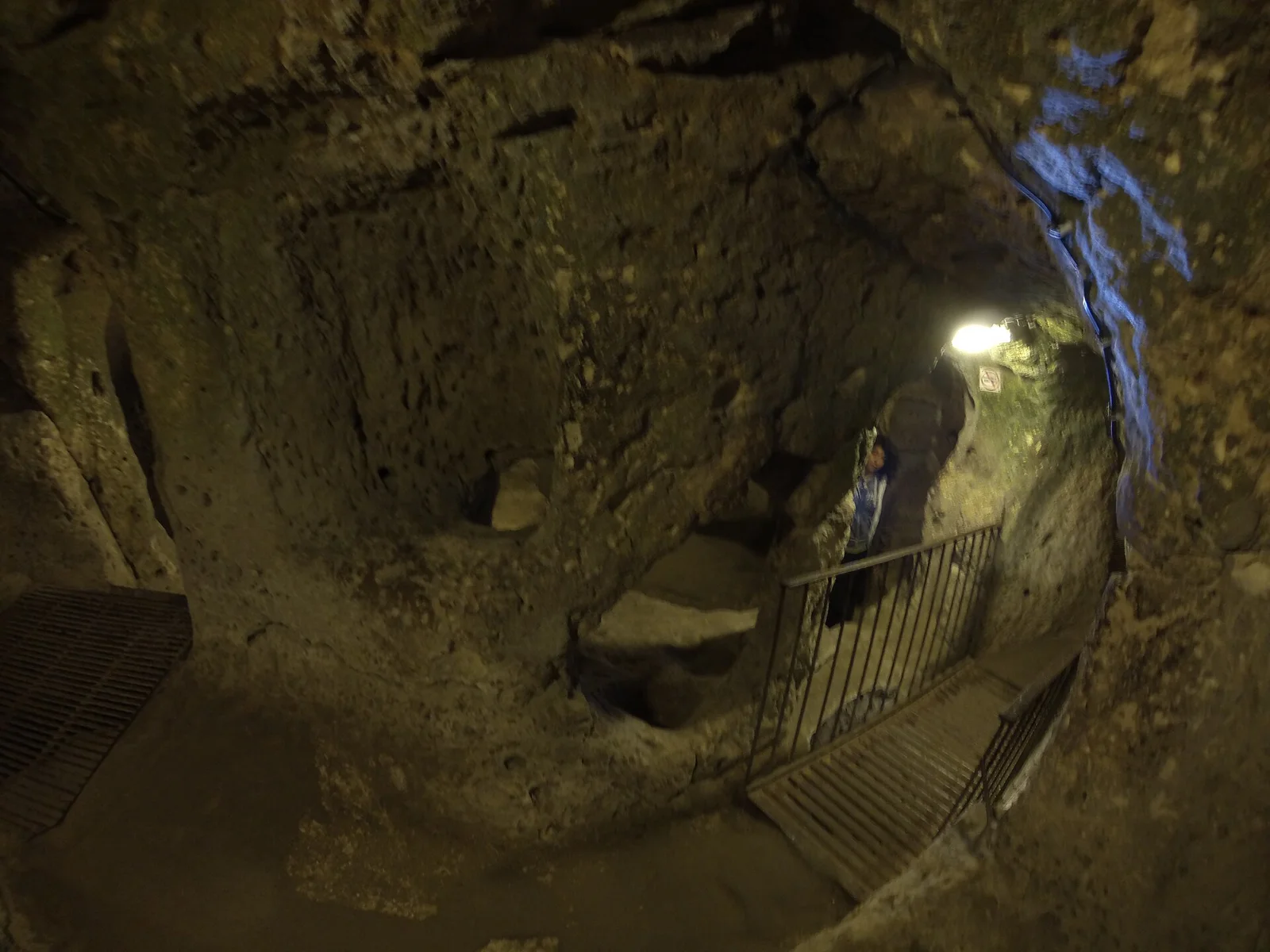
The hero photo on this page shows a feature within Derinkuyu with a modern rail. It is not captioned as a measured well or a view of its full depth. That distinction keeps the image's direct evidence separate from the broader well account. The credit records who made the photo and the licence under which it is used.
Stay within the marked route. A rail, cover or closed passage is not an invitation to inspect the feature more closely. Do not lean over an opening to obtain a depth estimate or lower an object into it. The museum's access rules are more useful during a visit than a historical drawing in a guide.
A guided explanation can be useful if it names the feature and its source. Ask whether the well label comes from the museum plan or from the guide's own inference. If a precise depth is quoted, ask what the measurement refers to. A shaft, a well and the lowest visitor room may have different figures.
Current water quality is a different question
This is a historical guide, not a drinking-water report. None of the consulted museum descriptions provides a current test result for water at the site. An account of earlier use cannot show present quality. This page therefore gives no drinking-water recommendation for a well or shaft.
The same applies to a claim that clear-looking water must be safe. Appearance is not a test. A photo cannot show the full condition of a supply. If a venue offers water for drinking, the useful question is its present arrangement and advice, rather than a historical story about the underground city.
When reading a travel article, keep its tenses clear. “The museum describes a well used for water access” concerns the site's account. “The water is drinkable” is a current claim with a different evidence burden. It should not be added as a casual ending to the first statement.
Evidence gaps and source questions
A fuller technical account would name each water feature on a plan. It would distinguish a measured depth from a repeated estimate. It would record what is known of the water level and explain the basis for any proposed connection. A history of use would then need evidence for when and by whom those features were used.
The geology and joint thesis by Mutlu is useful for the host rock and the measurement distinctions discussed in its literature review. It is not a current water-quality certificate. Its value should not be expanded into claims outside its stated purpose.
For a visit, ask a smaller set of questions. Which well or shaft can be seen from the present route? What does the museum call it? Does the guide's figure describe that feature or another one? These questions are practical and can be answered without pretending that the entire supply network is known.
Checklist for a water claim
- Name the feature rather than use “all the shafts”.
- Keep the museum account beside its source.
- Identify the reference points of any depth figure.
- Separate water access from water storage and water quality.
- Treat protective purpose as an account unless a study proves more.
- Avoid size or duration estimates without a stated method and inputs.
Read the museum's well-access statement closely
The Turkish Museums description says that not every floor could benefit from the wells extending downwards. It also describes some well mouths as unconnected with the surface. These are two distinct parts of its account, checked October 2026. They should not be shortened to a claim that every room had its own protected water supply.
For someone reading a plan, that distinction changes what to look for. A shaft drawn through several levels does not show a place to draw water at each level. A floor might lie beside the line without having an opening into it. The source would need to identify that access before the drawing could support such a claim.
It also changes the question about carrying water. A well's existence and access from a given room are separate matters. The museum account supports a discussion of water provision, but not a complete daily carrying route. On a guided visit, ask where the well was reached and which source labels that point. This is a more focused question than asking whether the entire city had running water.
Continue planning your visit
Verdict on Derinkuyu water
Derinkuyu water sources support an account of wells and of a shaft with a reported dual role. They do not show a complete measured supply system, a proved poisoning defence or present drinking-water quality. Read the features through their labels, and keep each claim within the evidence supplied for it.