
Why Was Derinkuyu Abandoned? Occupation and Later Use
Independent guide; not the museum operator or an official ticket seller.
Examine what abandonment means at Derinkuyu, with regional population change kept separate from room-specific use and modern rediscovery.
Last updated October 2026
Contents12
- Why was Derinkuyu abandoned: define the question first
- Evidence for later use and refuge use
- Regional population change
- End of use versus modern rediscovery
- Comparing the possible meanings
- What remains uncertain
- A cautious timeline
- Reading an abandonment claim on a visit
- FAQ: why was Derinkuyu abandoned?
- What the population-exchange document actually dates
- Continue planning your visit
- Verdict on why Derinkuyu was abandoned
Why was Derinkuyu abandoned? The available sources do not show one final evacuation of an underground city lived in full time. The museum and UNESCO describe refuge use, while regional history includes major population change. A firm answer about the end of use needs local evidence for the people, rooms and period being discussed.
“Abandoned” can mean that refuge use ended, a room stopped being maintained or access to part of the complex was lost. Those are different events. The population exchange is a documented regional change, but the treaty does not date the last use of a Derinkuyu room. Keep the end of earlier use separate from the modern discovery and museum opening.
Why was Derinkuyu abandoned: define the question first
The word “city” can make us imagine a place occupied in the same way every day. The UNESCO account of Cappadocia's rock sites instead discusses underground settlements as refuges in a wider landscape of settlement. That allows for periods when the refuge was not used. Source checked October 2026.
A refuge can be left when it is no longer needed, then used again later. A storage room can remain in use when a nearby passage is not. A closed entrance can hide some spaces while other openings remain known. These are possible patterns to distinguish, not a reconstructed sequence proved for every part of Derinkuyu.
To ask why the place was abandoned, first decide which kind of end you mean. The end of shelter during a threat is different from the end of all use. The departure of a local community is different from the loss of access to a given room. One date cannot be assumed to answer them all.
The Ministry's museum description names several room functions and places the site in a refuge history. It does not provide a dated final-use record for each space. The source supports the museum's account of use, but it cannot settle one final departure event for the full complex.
Evidence for later use and refuge use
A stronger end-of-use claim would need evidence tied to the site. That might include a dated local record, a named account from users or an excavated context which marks a last phase. Name the rooms or entrances that the record concerns. A regional narrative alone is too broad.
The types of evidence answer different questions. A local record could name people using a space. A closed opening might show a change in access, but its date would still need to be shown. An object could give information about activity in a room, while leaving the date of its first cutting unknown.
Even a dated object does not automatically prove the last use. It could be an old item retained much later. It might have been moved into the room after the activity being discussed. A study of finds should explain the context, rather than use the object's date as an instant answer.
The cited sources do not date the final use of each room. The gap is specific. It does not mean that no one used the rooms later, or that an archive cannot hold further evidence. It means the material consulted here does not support a single precise last-use date.
Regional population change
The population-exchange convention signed in 1923 is a primary record of a major policy affecting communities. Its terms define the groups subject to the exchange by nationality and religion, and state exceptions. It is useful background when reading accounts of later Cappadocian settlement.
The convention does not name the final occupants of Derinkuyu's underground rooms. It is not a local departure list or a site-use record. This guide therefore does not treat the treaty date as proof that every room below ground was vacated at that moment. The local link needs local evidence.
Many short accounts attach the end of underground use to the departure of Christian communities. That can be a hypothesis to check against local records. To make it a firm site claim, the account should name the community, the type of underground use and the evidence connecting that use to its departure.
Be careful with language about identity. The treaty's categories and exceptions should not be shortened into an assumption about every person in a named town. Nor should the history of displacement become a casual explanation for a picturesque ruin. Name the policy when you discuss it. Keep the human story apart from the tourism account.
End of use versus modern rediscovery
The modern discovery account is about renewed access and attention. It is not a direct record of the last earlier use. An entrance could be exposed long after some rooms stopped being used, or access could change while knowledge of other spaces survived. The discovery event does not settle that interval.
The district governor's indexed public account reports a chance discovery in 1963. The page could not be retrieved during our October 2026 check, so this guide uses only the attributed public statement. It does not turn the popular wall and chicken details into proof of a complete loss of local knowledge.
The museum's opening is yet another event. The Turkish Museums record gives 1965, while the district's account gives 1967. Those official statements conflict. Neither year is evidence for the date when refuge use ended. Sources checked October 2026.
This makes the sequence easier to read. Earlier use concerns the history of the spaces. Modern discovery concerns access or recognition. Public opening concerns museum operation. They may be related, but they need separate records and should carry separate confidence labels.
Comparing the possible meanings
| Meaning of abandonment | Evidence that would help | What is not enough |
|---|---|---|
| End of refuge use | Local account of the last sheltering event | A general history of conflict |
| End of ordinary room use | Room-specific records or dated contexts | The function named in a modern brochure |
| Departure of a community | Local departure and settlement records | A treaty without a site link |
| Loss of access | Dated record of a blocked or closed opening | A later story that an opening was found |
| Modern museum opening | Museum records of public operation | A claim about ancient use |
Scroll for more →
The table does not select one cause. It shows why different accounts may appear to answer the same question while actually discussing different events. A guide can usefully say which meaning it intends. A headline which leaves that out may be more dramatic than precise.
What remains uncertain
No consulted primary record shows a single day when all use ended. The cited accounts do not give a complete sequence for every room. A final community, a final refuge event and the final maintenance of an opening could each have a different date. The answer should retain those gaps.
There is also no basis here for a sudden catastrophe story. An empty-looking room does not prove a hasty flight. A blocked passage does not prove a siege. A large underground layout does not prove that its full population left together. Those claims would need positive evidence for the event being described.
Nor does the current lack of furniture prove that the rooms were emptied in one moment. The present museum appearance is a later state of the site. It cannot, by itself, show how objects were removed or when that happened. A photo is evidence of what the camera saw, not a complete record of what happened before.
The host rock adds no final-use date either. Mutlu's geology and joint study helps explain the material and form of the rooms. Its purpose differs from a study of the last occupants. A geological account should not be used to fill a historical gap simply because it is a named scholarly source.
A cautious timeline
| Stage | Record available here | Status |
|---|---|---|
| Regional refuge setting | UNESCO and museum account | Useful context; no final-use date |
| Population exchange | Primary convention text | Documented policy; site-specific end of use not proved |
| Last use of all rooms | No full local sequence located | Unconfirmed |
| Modern chance discovery | District public account | Reported event; details require a source trail |
| Opening to visitors | Conflicting official accounts | Separate from earlier use |
Scroll for more →
Use this timeline to place claims, rather than force the claims into a tidy story. If a new local source names the end of use for a given room, it can add a specific record. It would not automatically settle the history of every other room.
Reading an abandonment claim on a visit
Ask the guide what kind of use they mean. If they are talking about refuge, ask which period the account concerns. If they are talking about a local community's departure, ask which local record links it to the underground spaces. This brings the discussion closer to the evidence without requiring a debate over every detail.
Listen for a change of scale. A guide may begin with regional history, then use “here” to refer to one room. That transition needs support. The room could fit the broad history without having a proved final-use date. A careful explanation can say so while still making the visit meaningful.
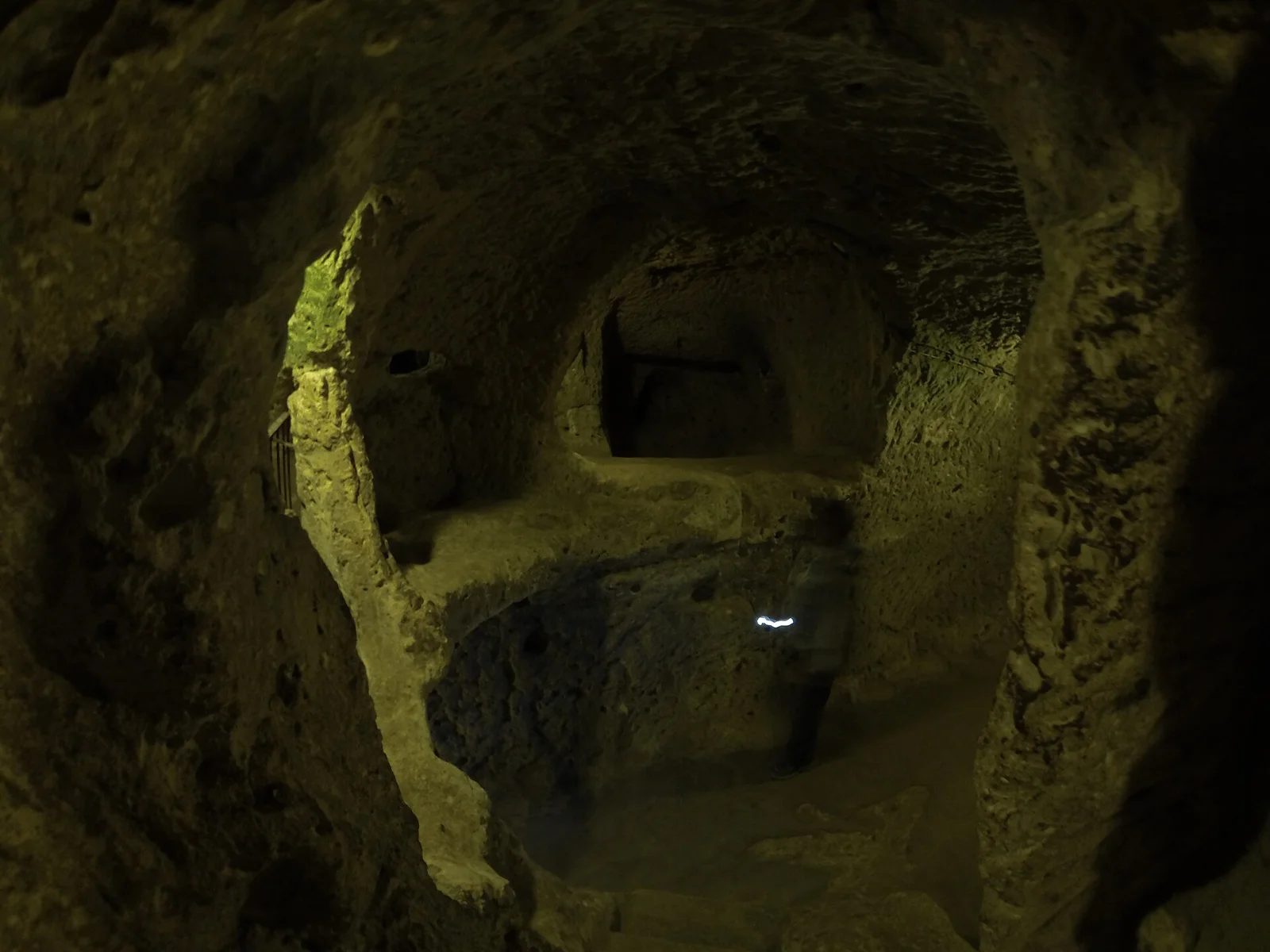
The visible features remain worth looking at. Room forms, openings and barriers show a place adapted for several needs in the museum's account. Their interest does not depend on a mystery evacuation. A layered account of use and change can be more revealing than one dramatic cause.
FAQ: why was Derinkuyu abandoned?
Was there one sudden evacuation? The cited sources do not document one final evacuation of the whole complex. The question should first distinguish refuge use from continuous use and later use of individual rooms.
Did the population exchange cause the end of use? The policy is documented. Its exact link to the last use of Derinkuyu's rooms needs local evidence. The treaty alone does not show that link.
Does modern rediscovery prove that nobody knew the site? No. Finding or exposing one access point does not prove that all knowledge of every space had vanished. The larger claim requires more evidence than the short discovery account.
Can a visitor see the last occupied room? The cited sources do not identify a room as the final occupied space. Ask for the source before accepting a precise label, and remain on the present marked route.
A last-use claim should therefore name its scale: one room, one entrance or the whole complex. That small label makes the historical question much clearer.
What the population-exchange document actually dates
The Turkish Foreign Ministry's text of the convention records a signing date of 30 January 1923. Its first article sets a separate commencement date of 1 May 1923 for the compulsory exchange it defines. These dates concern the agreement and its stated operation. Neither is a dated record of the last activity in a Derinkuyu room.
That distinction helps when comparing two accounts which both use the year 1923. One may be dating the convention. Another may be claiming a local departure. Ask whether the second account actually supplies a local record, rather than assume that the shared year proves the connection. The treaty is firm evidence for the policy it states.
It cannot identify a last underground occupant on its own.
For a visitor, the most accurate question is therefore which community and which use a guide means. An answer about storage, refuge or a particular entrance can be useful at that scale, without becoming a claim that the whole complex was vacated on one treaty date.
Continue planning your visit
Verdict on why Derinkuyu was abandoned
Why was Derinkuyu abandoned? The answer cannot be reduced to one proved final event from the sources consulted here. Regional refuge history and population change provide context. The end of use for a given space needs local evidence, while modern discovery and museum opening belong to a separate timeline.