
Derinkuyu Kaymakli Tunnel: Evidence and Public Access
Independent guide; not the museum operator or an official ticket seller.
Trace the Derinkuyu–Kaymakli tunnel claim to named literature and keep historical connection evidence separate from public access.
Last updated October 2026
Contents12
- What the claimed Derinkuyu Kaymakli tunnel is
- Trace the claim to its source
- What is surveyed or documented?
- Length and route uncertainty
- Can visitors walk between the cities?
- A practical two-site plan
- What would strengthen the historical answer
- Corrections and source notes
- FAQ: connection questions
- Plan two entrances if you want both museums
- Continue planning your visit
- Verdict on the Derinkuyu Kaymakli tunnel
The Derinkuyu Kaymakli tunnel claim concerns two distinct sites. Some accounts say they have a passage between them. It is not a checked public walking route. A named geology thesis cites an earlier account. It says no firm evidence for links between the sites had been found. Use surface transport for a visit to both museums unless the venues publish a different current route.
Keep three claims apart: passages exist within each city; a long connection between cities is reported in some accounts; visitors can walk that connection today. Evidence for the first does not prove the second or third. No unbroken surveyed route or current public-access notice for the inter-city tunnel was located for this guide.
What the claimed Derinkuyu Kaymakli tunnel is
The claim describes a passage running between Derinkuyu and Kaymaklı, rather than an ordinary corridor inside either museum. That distinction matters. Both official museum accounts describe rooms linked by passages. Those local links do not, by themselves, show a tunnel joining the two towns.
It is also a different claim from several openings being linked within one settlement. A network of rooms under a place can be large without reaching another city. A travel account may use the words “connected tunnels”. Ask what it means. It could mean links between rooms, local openings or a route between towns.
The Derinkuyu venue account and Kaymaklı venue account are useful for the museums' public accounts. We checked both pages in October 2026. Neither gives a public walking route between the museums.
This is not an assertion that no connection could ever be found. It is a statement about the evidence located here and what it can support. A newly published survey could change the historical answer. A venue route notice would be needed to change the visitor-access answer.
Trace the claim to its source
Mehmet Özgür Mutlu's 2008 thesis, printed page 14, discusses the question in its literature review. It cites Gülyaz and Yenipınar. It says firm evidence for the claimed links had not been found. This is a clear, named scholarly source with an explicit limit.
It is important to preserve the citation chain. The thesis is reporting an earlier account. It should not be described as a team walking and surveying every possible inter-city route. Nor does its statement prove that no further evidence has appeared since. Its value is the named warning it gives about the claim at that point in the literature.
If a later account says a tunnel has been proved, look for the work that changed the evidence. An unbroken survey, a published excavation report or a museum statement naming the route would be useful. A newer travel webpage may repeat the same old claim. Its date alone is not new proof.
Repeated wording can hide that problem. Several websites may quote a length and describe a connection as shown. If none names the survey, they may all depend on one untested account. The count of websites is not the count of separate inspections of the tunnel.
What is surveyed or documented?
Mutlu's thesis examines geology and joints in the two cities. Its abstract reports work on 46 Derinkuyu rooms and 64 Kaymaklı rooms. Those are useful facts about the scope of the study. They are not proof that the space between the two settlements was surveyed as an unbroken passage.
The official Kaymaklı brochure includes a city plan, while the Derinkuyu brochure includes its own drawing. These help with each site's recorded layout. Two separate plans do not show an unbroken link between their edges.
To show that link, the record would need to tie the points together. It should name the entrances or endpoints, show the route and explain how the survey was made. If there are breaks, blocked areas or inferred sections, those should be marked. A line added across a region map is not a substitute for that record.
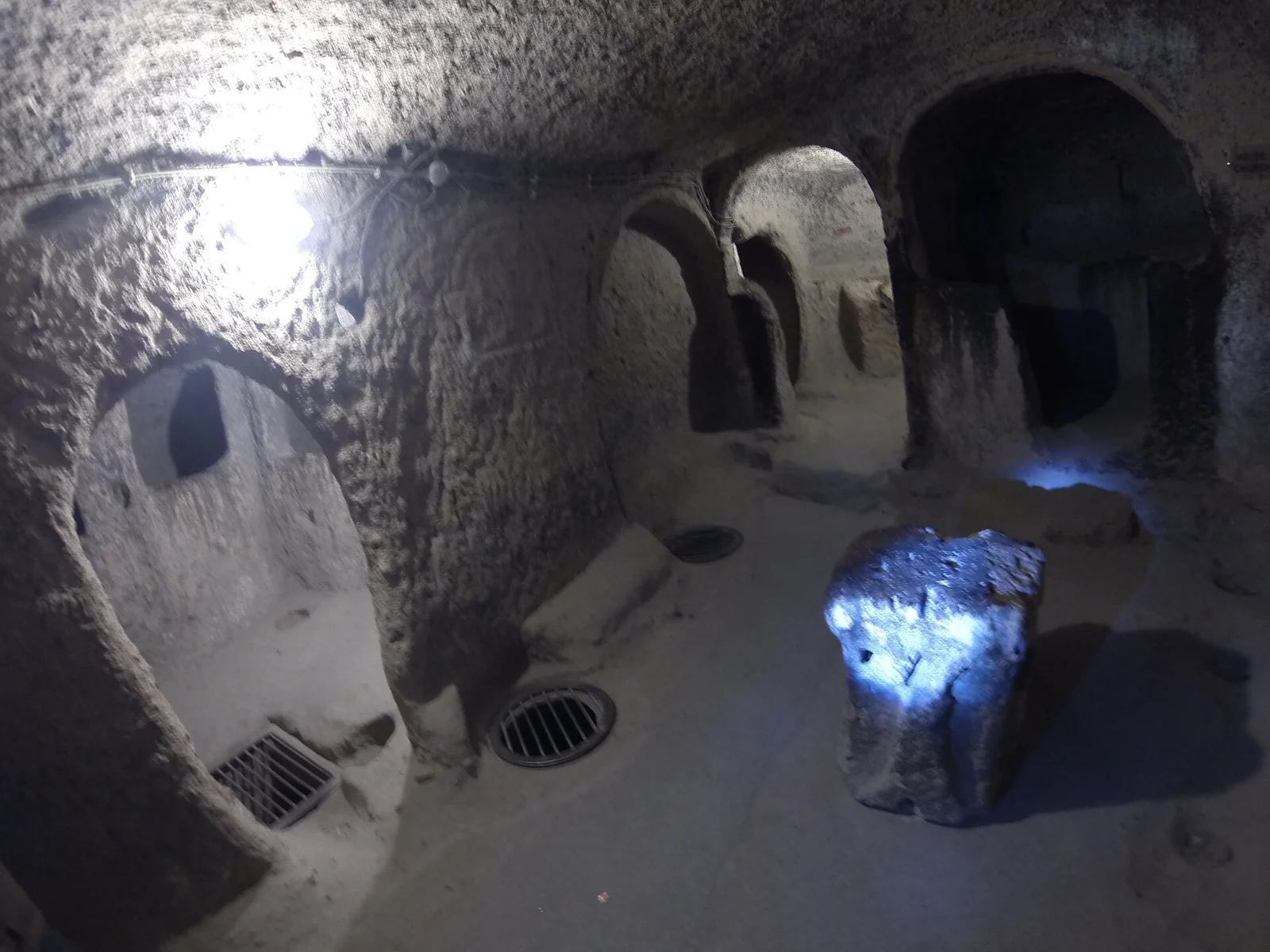
A photo has a narrower role. It can document a passage at a stated location and time. It cannot show where an unseen continuation ends. The hero on this page shows a Kaymaklı space, with credit beneath it. It is not presented as a photo of the claimed inter-city tunnel.
Evidence table
| Claim | Evidence located | Status here |
|---|---|---|
| Rooms link within Derinkuyu | Official museum account and site drawing | Documented local feature account |
| Rooms link within Kaymaklı | Official museum account and site plan | Documented local feature account |
| One unbroken inter-city tunnel | Claim discussed with a lack of firm evidence in cited literature | Not shown by an unbroken survey located here |
| Exact tunnel length | No measured full route located | No number adopted |
| Public walk between the museums | No current venue access notice located | Not a visit option in this guide |
Scroll for more →
The table keeps the old layout apart from present access. Even a documented old connection would not automatically be open to visitors. Public access would need its own current record. It should not be inferred from a historic plan or from a statement that a tunnel exists.
Length and route uncertainty
A length needs a defined route. A straight surface distance between two points is not the length of a passage below ground. A road distance is different again. A tunnel could bend or change level.
No surveyed path is shown. Using a surface figure for a tunnel length would invent a claim.
We therefore do not adopt a precise inter-city tunnel length. This is a better answer than repeating a familiar number whose endpoint and method are unstated. A source may give a length. Ask where the route starts and ends. Check how it was measured and whether the whole line was seen.
The same caution applies to depth. A shaft in one city does not show the depth of a connection to another. Nor do two similar depths prove that the rooms meet. A route would need both position and height information. Those separate measurements cannot be supplied by a single headline about the deepest well.
A schematic region map can still be useful. It can show that the two museums have separate locations and help plan surface travel. Its caption should make clear that no underground connection is drawn.
A dashed line can look like a route. It may mean only a possible link. We do not add one here.
Can visitors walk between the cities?
No current public walking connection is shown by the sources used in this guide. Plan the two museums as separate visits reached by checked surface transport. An old account may describe a link. It does not give permission to enter a closed passage or leave the marked route.
A seller may claim to offer the walk. Ask for the venue permission and current route notice. Check these before treating it as a real product. The account should name the starting point, endpoint and access authority. A broad claim of a secret or exclusive tunnel is not enough to support the visit.
Within either museum, follow the marked visitor path. A barrier or side opening may be part of the documented site while remaining outside public access. The museum's current directions take precedence over a plan downloaded from the web. Do not try to test the connection claim by leaving the route.
For a visit to both sites, ask a driver or tour operator to name both stops. Confirm the transfer, entry inclusions and time allowed in each museum. This gives you an actual two-site day without relying on an unconfirmed underground journey. A tour title alone may refer to only one city.
A practical two-site plan
Begin with a reason to see both. You might want to compare the room layouts or the museum accounts of refuge use. If your interest is mainly Derinkuyu, one well-planned visit may be enough. The possible tunnel claim should not be the only reason for adding a second museum.
Next, confirm the two sets of admission and hours. The official portals publish conflicting schedules, so ask each venue for the times on your date. Keep the last admission separate from closing. A second visit should not depend on arriving at an unchecked late cutoff.
Then arrange the surface transfer. Ask about the pickup point after the first museum and the return from the second. A quote should state whether waiting is included. For public transport, check the full chain of services. A town-to-town ride may not run at the time you need.
Finally, leave enough flexibility to drop the second visit if access or transport does not work. This is a planning choice, not a claim about typical crowd levels. A checked single visit is more useful than two intended stops connected by an unknown journey.
What would strengthen the historical answer
A stronger report would name a surveying team and provide an original route record. It would distinguish observed sections from inferred ones. It would give a method, scale and reference points.
A section may be blocked or out of reach. The record should show that gap. It should not draw a full line through it.
An excavation report could also be useful if it named a passage and its context. But finding a tunnel heading in a certain direction does not show its destination. The report would need to support the full connection claim, not just show that a local passage exists.
A current museum statement could change the access answer on its own. It might announce a route within one site without proving an inter-city link. That is why the record should name the actual place and extent. The word “new tunnel” can refer to several quite different developments.
Until such a record is located and read, the answer remains limited. That does not diminish the documented rooms and passages already known at each museum. Their interest does not depend on the existence of a long connecting tunnel. A source-based visit can focus on features the venues actually name.
Corrections and source notes
The key scholarly passage is on printed page 14 of Mutlu's thesis, which is PDF page 28. The page cites earlier literature rather than presenting a new unbroken route survey. Keeping that page reference helps readers inspect the exact scope of the statement.
Official venue and brochure sources were checked in October 2026. They support local feature accounts and separate museum planning. No current inter-city public-route notice was located. A useful correction should name an original survey or venue record, rather than add another unsourced travel summary.
FAQ: connection questions
Does the thesis prove there is no tunnel? It reports that firm evidence had not been found in the earlier literature it cites. It is not proof that no possible connection exists or that no later work could change the answer.
Does a line on a tourism map prove a link? No. The line needs a surveyed source and a clear statement of what it represents. A road or a straight distance between towns is not an underground route.
Should I plan to walk between them underground? No public route is shown here. Use checked surface transport and the present marked route within each museum.
Check the survey's extent before treating a new plan as proof. A drawing of one city can be accurate and useful while stopping at its own recorded boundary. If a claimed connection lies beyond it, that part needs a separate source. The absence of a connecting line is not proof that no passage exists; the presence of an added line is not proof that one was surveyed.
A source can also document a short heading without naming its endpoint. Retain that limited finding rather than enlarge it into an inter-city route. The complete claim needs evidence for the full connection, not only a tunnel pointing in a possible direction.
Plan two entrances if you want both museums
The Derinkuyu Ministry listing and Kaymaklı Ministry listing give separate venue addresses. Neither page offers a visitor walk through a tunnel between them. That makes two surface arrivals the usable planning basis, regardless of how a historical connection is described. Sources checked October 2026.
For a driver quote, name both museums and the order. Ask where you will meet after the first visit and whether the driver waits through the second. Do not describe the journey simply as a transfer to an underground city. That leaves the supplier free to understand one entrance when you intend two.
At the first museum, follow its marked exit even if an old plan shows a passage continuing further. A possible historical link would not establish current public access, lighting or an authorised end point. If the second venue cannot fit its admission window, change the surface plan. An unconfirmed underground shortcut is not a way to recover a late arrival.
Keep the two questions clear. A historian can ask for the survey behind the claim. A visitor can arrange two museum visits. Neither task requires pretending that an advertised inter-city tunnel walk exists.
Continue planning your visit
Verdict on the Derinkuyu Kaymakli tunnel
The Derinkuyu Kaymakli tunnel is a reported connection whose unbroken survey evidence was not located for this guide. It is not a checked public walk. Keep local passages, historical connection claims and current access separate, and plan two museum visits with surface transport.